Want to be the first choice when local customers search for your services? Local SEO is the key to making that happen. But what is Local SEO, and how can it help you dominate local search results?
Local SEO ensures that your business ranks high in local searches, driving more foot traffic and online inquiries. According to the 2025 Local Consumer Review Survey, 83% of consumers use Google to find local business reviews, highlighting the immense potential of local SEO.
In this guide, we’ll walk you through the do’s and don’ts, tools you should use, and the exact steps we follow to achieve real results for businesses like yours.
What Is Local SEO?
Local SEO is a method of getting your business to be visible in the search results of Google whenever someone searches for a business near their location.
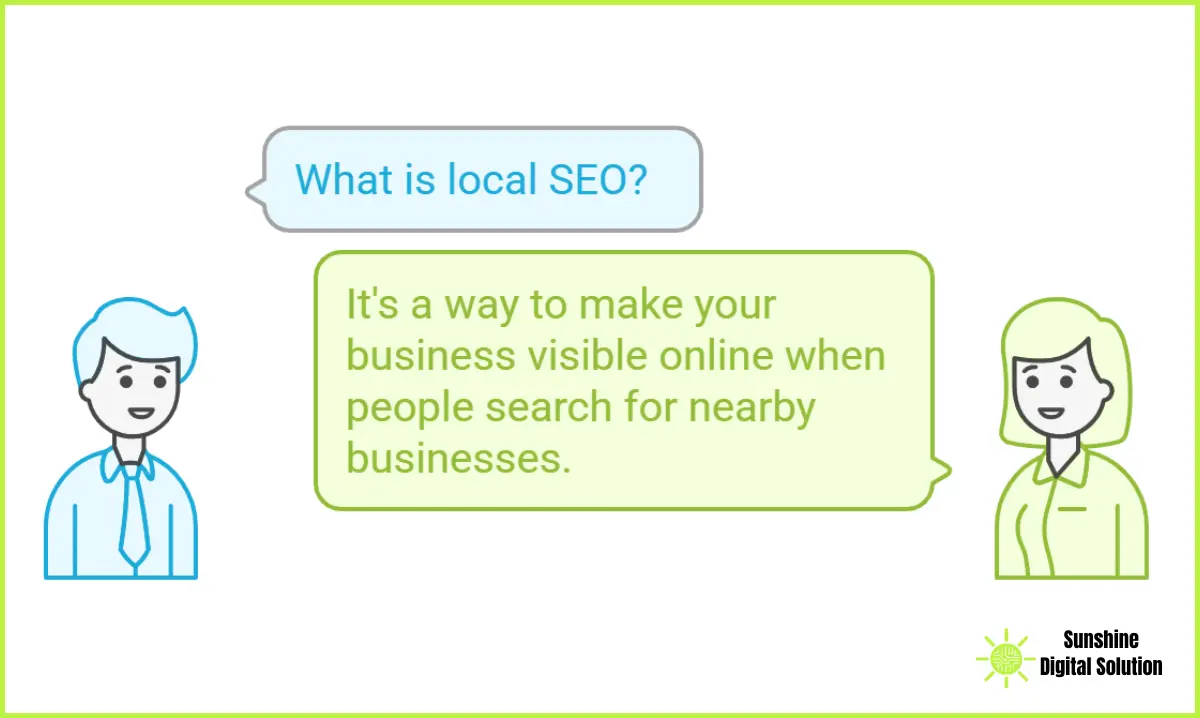
It helps in the optimization of search queries such as “restaurant near me” or “plumber in [city name]”. Some of the examples are adding the business to Google Maps, targeting specific geographical locations in the business’s keywords, and receiving local reviews.
Is Local SEO Limited to Google Only?
Local SEO goes beyond Google. Google may dominate search traffic, but there are plenty of other platforms where it’s just as important to optimize your local business. Search engines like Bing, mapping services like Apple Maps, review platforms like Yelp, and social media sites such as Facebook all play a role in local visibility.
Why Is Local SEO Important?
Today, customers want answers fast, and local SEO makes sure your company appears when they search. People now want to know where to find specific things rather than just a place to visit, thanks to the popularity of “near me” searches. Local SEO literally places your company on the map, whether it’s for a service, product, or even an experience.
Smartphone users have come to expect search results specific to their location, no longer required to type out ZIP codes or neighborhoods. More focused searches like “where to buy vinyl records near me” or “open restaurants near me now” have replaced more general ones like “restaurants near me.” The outcomes? Sales and brand recognition are increased when potential clients find your company at the perfect time.
According to Google, “near me” mobile searches, which include variations like “can I buy” or “to buy,” have increased by more than 500%, providing a clear illustration of purchase intent. This increase demonstrates how consumers are using mobile searches to pinpoint exactly what they need, where to find it, and when to buy it.
Local SEO makes sure your company is seen by people who are in urgent need of your goods or services, which is important as the demand for quick fixes rises. Businesses that optimize for local search are better positioned to attract this ready-to-buy audience, as evidenced by the rise in mobile searches for phrases like “___ near me now” and “restaurants open now near me.”
How Does Local SEO Work?
Three primary criteria are used by Google to determine local search rankings: proximity, relevance, and Prominence.
1. Proximity
This refers to how close a business is to the searcher’s location. Google uses the physical location of the user to determine which businesses are closest and most relevant to their search. For example, if someone searches for “best coffee shop near me,” Google will prioritize coffee shops that are closest to the searcher’s location.
2. Relevance
Relevance is about how well a business listing matches what the user is searching for. Google looks at the information available in a business’s Google Business Profile, website, and other online sources to determine if a business offers what the user is looking for. Keywords, services, and business descriptions play a crucial role here.
3. Prominence
Prominence measures how well-known or trusted a business is. Google looks at factors like online reviews, ratings, backlinks, and overall web presence. If a business has a lot of positive reviews, high ratings, and is frequently mentioned on other websites, it will likely be ranked higher. Prominence also refers to how well-established the business is in its field, based on its authority in search results.
These three factors work together to determine which businesses show up in local search results, making it essential for businesses to focus on optimizing each one to rank well in local searches.
⚡
Pro Tip
Local SEO is incredibly powerful, but to truly maximize growth, it’s important to understand when to leverage
local SEO vs PPC (paid ads). Knowing when to combine both strategies can help you achieve the best results.
How You Do Local SEO?
Local SEO involves optimizing your online visibility for searches specific to your geographic location. Here are the key steps to effectively implement local SEO:
1. Create Your Google Business Profile
Google Business Profile (GBP) is a free tool provided by Google that allows businesses to manage their online presence across Google Search and Google Maps. By creating and optimizing a GBP, businesses can provide important information, making it easier for potential customers to find them when searching locally, like:
- Location
- Contact details
- Business hours
- Photos and videos
- Services
To make it simpler for local clients to locate and get in touch with Sunshine Digital Solutions, we have set up a Google Business Profile (GBP). We have made sure that all of our company information, including our name, address, phone number, and working hours, is correct and consistent online by claiming and validating our profile.
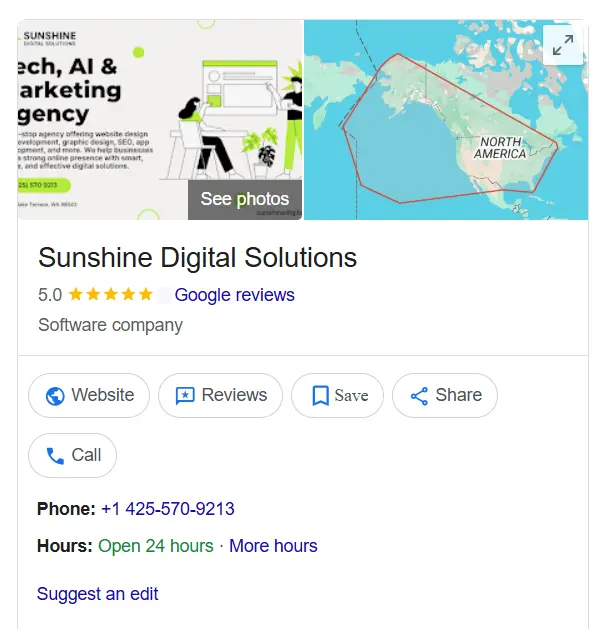
To make sure Google is aware of the precise services we provide, we have carefully chosen categories like “Software company” and “Digital marketing agency.” We frequently post excellent images and videos of our work and team to build trust and provide prospective clients with a visual representation of our identity and capabilities.
We encourage satisfied customers to post reviews on our profile because they are very important to our local SEO. In order to demonstrate our concern for our customers’ experiences, we also make sure to reply to reviews. We keep our profile active and interesting by sharing news, offers, and updates via Google Posts.
We make sure Sunshine Digital Solutions remains visible to our local community and keeps improving in local search results by keeping everything current. To make sure that we reach the people who need our services the most, this constant optimization is important.
2. Local Keyword Research
Local keywords are specific phrases that people use when searching for businesses or services in their area. For example, instead of just searching for “IT company,” someone might search for “IT company near me” or “software company in Washington.” These keywords help businesses show up in local search results when potential customers are looking for services nearby.
To find local keywords, we use a few methods:
1. Use Google Autocomplete Suggestions
Google automatically provides search suggestions based on popular search queries related to the term you type in. This is a great way to discover local variations of keywords. For example, when we typed “digital solutions” into Google, the search suggestions might show us related terms like “digital services near me,” “digital marketing solutions near me,” or “digital solutions company near me.”
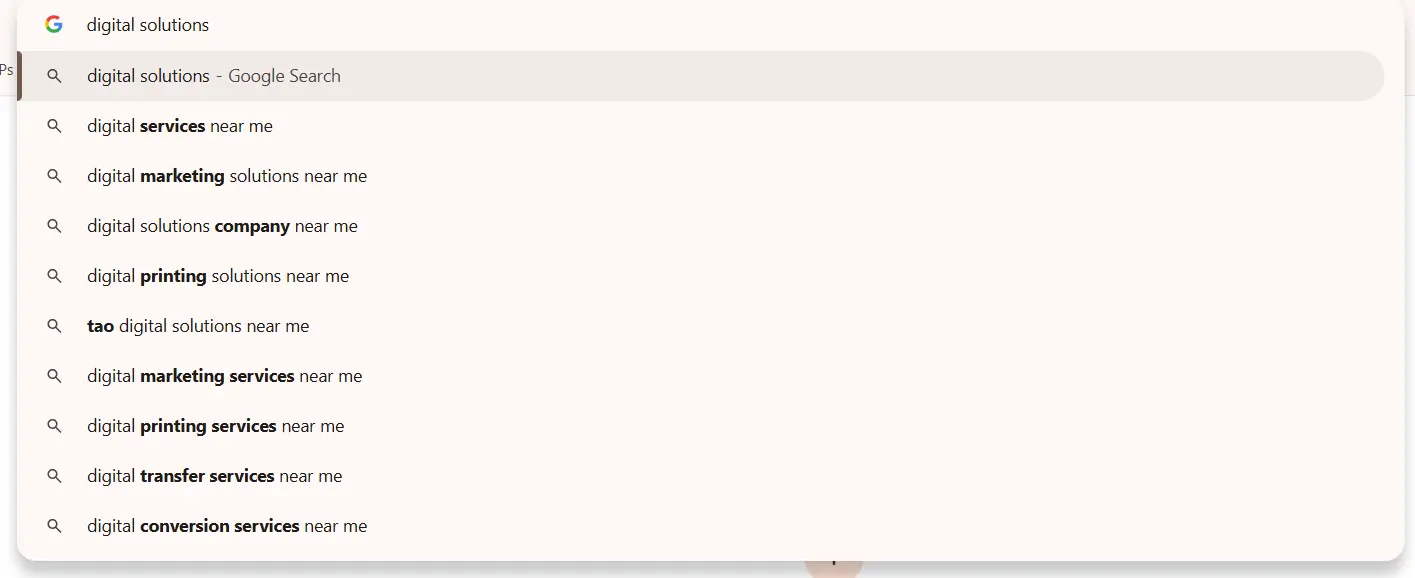
These suggestions are based on real user searches, meaning they are high-value keywords that can drive traffic from people searching for services close to their location. By noticing the autocomplete suggestions, we can find relevant local keywords to target.
2. Google Keyword Planner
Google Keyword Planner is a free tool that allows businesses to find local keywords based on search volume and competition. Here’s how we use it at Sunshine Digital Solutions:
- We enter terms related to our business, such as “software company” or “IT services.”
- Google Keyword Planner then generates a list of related keywords along with important data like search volume, competition level, and suggested bid prices for paid ads.
- We filter these keywords by location to make sure we are focusing on terms that are popular in Washington. For example, we can search for “IT company near me” and see how often people in Washington are searching for it.
- From this list, we can choose keywords with high search volume and relatively low competition, which gives us the best chance of ranking well.
3. Competitor Research
Another effective way to find local keywords is by analyzing what keywords our competitors are targeting. Here’s how we do it:
- We identify businesses in Washington that offer similar services to Sunshine Digital Solutions, like local IT companies or software service providers.
- Using SEO tools like Ahrefs or SEMrush, we can look at their top-ranking pages and the keywords they are ranking for. These tools show us the exact phrases that bring traffic to their website.
- By reviewing their keyword strategies, we can find local keywords they are targeting, which may be relevant for us as well.
- If we notice competitors’ ranking for “software company near me” or “IT services in Washington,” we can optimize our own website with these keywords, ensuring we compete effectively in local search results.
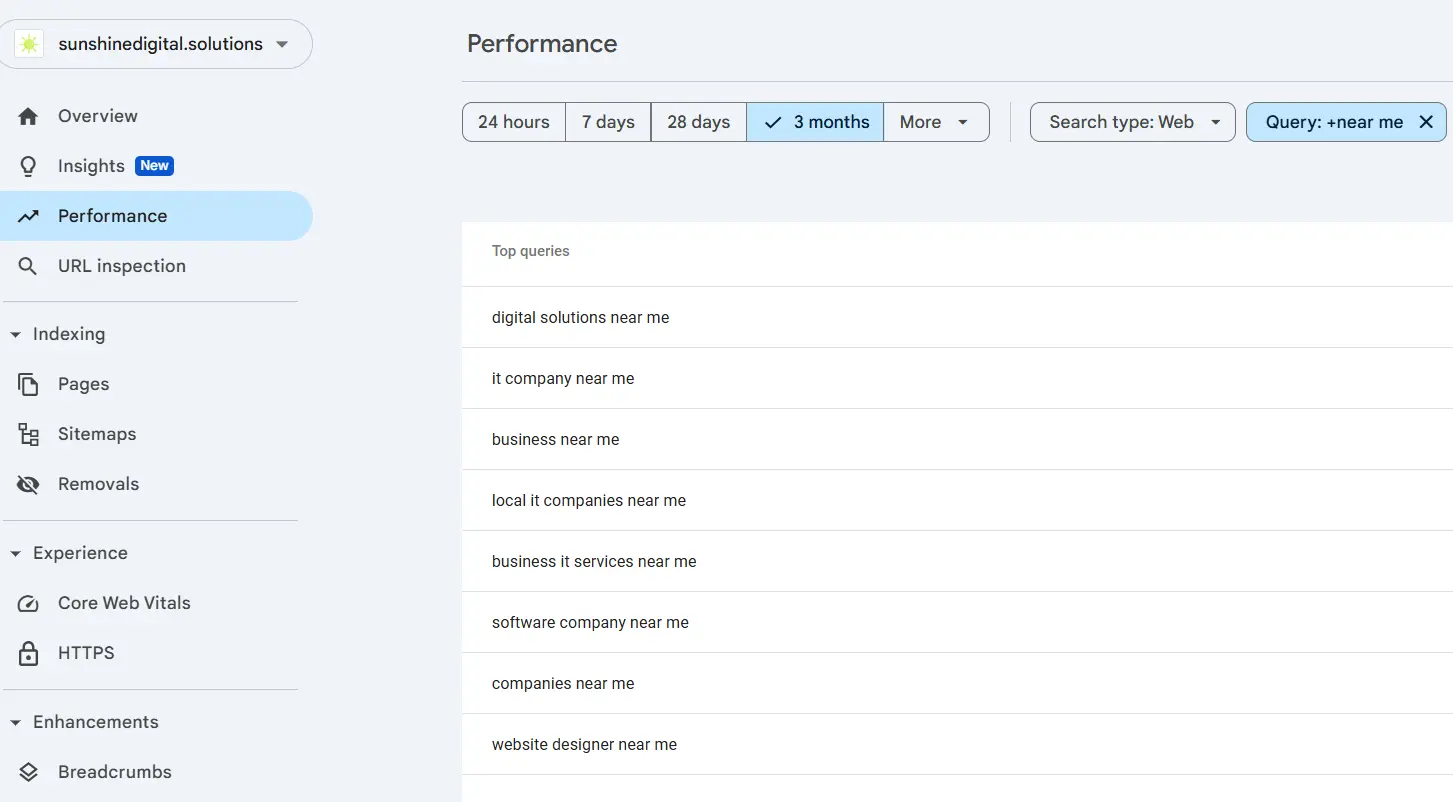
For Sunshine Digital Solutions, we’ve optimized for local keywords such as “digital solutions near me,” “IT company near me,” “local IT companies near me,” and “software company near me.” Since we are located in Washington, we strategically include “near me” and “Washington” in our keywords to ensure that we rank for searches relevant to customers in and around our area.
The image below from Google Search Console (GSC) highlights how these keywords are currently performing, showcasing the impact of our local SEO efforts.
3. Local Citations
Local citations refer to any online mention of your business’s name, address, and phone number (NAP) on other websites, even if there’s no link to your site. These mentions can appear on local business directories, review sites, social media platforms, and even blogs. Local citations help establish your business’s presence in the local community and are a key factor in local SEO.
When your business is listed on reputable directories like Yelp, Yellow Pages, or local chamber of commerce websites, it signals to search engines like Google that you are a trusted and relevant business in the Washington area. Consistent and accurate NAP information across these citations improves our credibility and search engine rankings, making it easier for potential customers to find us.
Encouraging and responding to online reviews is a crucial part of building trust and improving local SEO.
- Encourage Customers to Leave Reviews
Sunshine Digital Solutions actively encourages our satisfied customers to leave reviews on platforms like Google, Yelp, and industry-specific sites. You can do this by sending follow-up emails after a service is completed, asking customers to share their feedback. Offering incentives, like discounts or small rewards, can also motivate clients to leave positive reviews.
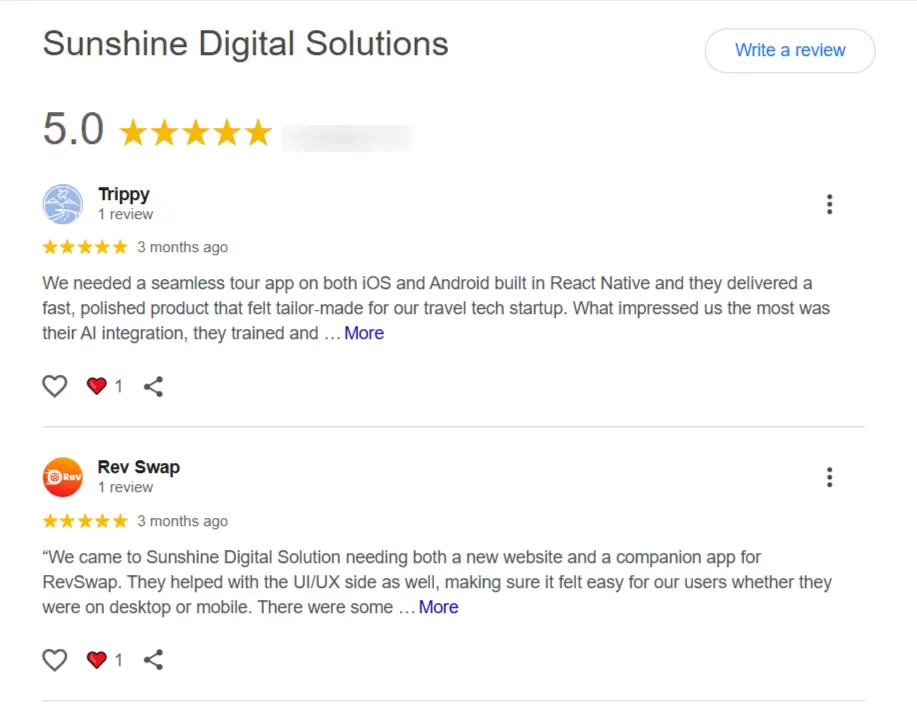
- Respond to Every Review
Whether the review is positive or negative, responding to everyone shows potential customers that we value feedback. For positive reviews, we thank the customer and express our appreciation for their support. For negative reviews, we acknowledge the issue and offer a solution, showing that we are committed to customer satisfaction. This helps to build trust and improve our reputation. - Make Reviews Easily Accessible
We make it simple for customers to leave reviews by providing direct links to our review platforms on our website and in our follow-up emails. The easier we make it, the more likely customers will leave feedback.
By encouraging reviews and engaging with them, you are not only boosting your online reputation but also improving your local SEO rankings, making it easier for potential customers in your area to find and trust your services.
4. On-Page SEO Optimization
On-page SEO optimization refers to the changes and improvements made directly on your website to help it rank better in search engine results, particularly for local searches. Here’s how Sunshine Digital Solutions has optimized its website for local SEO:
- Optimize Title Tags and Meta Descriptions
Each page on our website should have a unique, keyword-optimized title tag and meta description. For example, the title of our homepage could be “Sunshine Digital Solutions, Washington’s #1 Digital Marketing Agency”. This helps search engines understand what the page is about and ensures our business is shown in local search results for relevant terms like “Digital Marketing services in Washington.” - Use Local Keywords Naturally
We incorporate local keywords such as “digital marketing in Washington” and “software company near me” throughout the website’s content. This includes headers, body text, and image alt texts. However, it’s important to make sure the keywords flow naturally and are relevant to the content. - Add Location-Based Content
To improve local ranking, it’s important to create content that is relevant to your specific location. For example, businesses can add a dedicated page such as “Services in [City Name]” to highlight what they offer to the local community. Additionally, writing blog posts about local events, news, or trends can help attract nearby customers. Sharing case studies or success stories that feature work with local clients is another effective way to build local relevance and trust. This type of content signals to search engines that your business is actively involved in the local area, improving visibility in local search results. - Optimize for Mobile
Since most local searches are now done on mobile devices, it’s essential to have a mobile-friendly website. We ensure our website is responsive and easy to navigate on any device, offering a seamless experience for mobile users.[add screenshot] - Improve Site Speed
A fast-loading website is not only important for user experience but also for search engine ranking. We regularly monitor and optimize our website speed by reducing image sizes, leveraging browser caching, and improving server response time.
By optimizing these on-page SEO elements, Sunshine Digital Solutions ensures that our website is properly aligned with Google’s ranking factors, increasing the chances of appearing in local search results for users looking for IT and digital services in Washington.
5. Build Backlinks for local SEO
Backlinks are links from external websites that point to your site. They are considered one of the most important ranking signals in Google’s algorithm. When a reputable site links to your business, it essentially vouches for the value and credibility of your content. This tells search engines that your website is trustworthy and relevant, which helps improve your search rankings.
To increase your chances of ranking higher, it’s essential to focus on acquiring backlinks from domains that are highly relevant to your business. For example, getting links from local businesses or industry-specific sites is more beneficial than getting links from unrelated, generic sources.
While traditional link-building strategies, like reclaiming lost links, broken link building, and finding unlinked brand mentions, are well-known and effective, these methods can also be adapted for local SEO. Here are some local link-building tactics that can help boost your visibility:
- Reach Out to Local Businesses (Non-Competitors)
You can collaborate with local businesses that aren’t direct competitors to gain backlinks. For instance, if you run a marketing agency, you might partner with a local marketing agency or a small tech company, offering mutual backlinks to each other’s websites. This builds a supportive local network that enhances both businesses’ SEO. - Contact Local Newspapers and Websites
Local news outlets, blogs, and websites are always looking for relevant stories to share. If your business is involved in a local event, milestone, or charity project, you can reach out to these sites to share the news and get a backlink in return. This not only improves your SEO but also helps your business gain exposure within the local community. - Support or Sponsor Local Events
Sponsorships or partnerships with local events, charities, or organisations often lead to valuable backlinks.
By focusing on local link-building and acquiring high-quality, relevant backlinks, Sunshine Digital Solutions can significantly improve its local SEO performance, making it easier for nearby customers to find and engage with our services.
When selecting the right strategies for local SEO, partnering with the right team can make all the difference. If you’re unsure about how to implement these steps or need expert guidance, choosing an SEO agency can be the key to unlocking your business’s full potential.
Want to see how Sunshine Digital Solutions can make a difference for your business? Call us today!
📌
Pro Tip
If your business operates in more than one city or region, don’t stop at basic local SEO. Perform
local SEO in multiple locations, a strategy that helps each branch rank independently in its area. By creating unique location pages and optimizing each Google Business Profile, you can attract local customers from every market you serve.
How Do You Monitor Local SEO Results?
Making a Google Business Profile (GBP) is not enough; you need to monitor your local SEO on a regular basis to know if it’s actually bringing in customers. Sunshine Digital Solutions tracks results through a mix of tools and insights to make sure your business is not just visible online but also generating real leads.
- Check Local Keyword Rankings
We keep an eye on the important keywords your customers are searching for, like
“dentist near me” or
“best pizza in [city].” Rankings can change depending on the location of the search, so we use special tools that show how visible your business is in different areas of your city.
- Review Google Business Profile Insights
Your Google Business Profile is often the first thing people see. We monitor how many times it shows up in searches, how many people clicked for directions, called you, or visited your website directly from that profile. This tells us if your profile is attracting real customers.
- Track Local Pack Performance
You know those 3 businesses that appear on Google Maps at the top? That’s the
local pack. We measure how often your business shows up there compared to competitors. The more often you’re in the top 3, the more chances you have to get new customers.
- Look at Website Traffic & Conversions
We don’t just track how many people visit your website—we also track what they do when they get there. Are they filling out a contact form? Booking a service? Calling your business? This helps us understand if SEO is bringing in just visitors or actual paying customers.
- Monitor Reviews & Reputation
Good reviews are gold for local SEO. We track how many new reviews you’re getting, your star rating, and even what people are saying about you. More positive reviews mean more trust, better rankings, and more customers choosing your business.
What Role Do Reviews and Reputation Management Play in Local SEO?
Reviews and reputation management play a crucial role in local SEO, as
they influence how businesses are perceived online and impact search engine rankings. Here’s how they work:
- Credibility and Trust: With prospective clients, positive reviews increase credibility and trust. Both customers and search engines are alerted that a company is trustworthy and offers high-quality services when it has a large number of positive reviews.
- Google My Business (GMB) Ranking: A company’s Google My Business ranking is directly impacted by reviews. When deciding which local businesses to show in search results, Google considers reviews. Positive reviews increase a company’s likelihood of ranking higher in local search results.
- Local Relevance: Reviews from customers also assist search engines in determining how relevant a company is to a particular location. A business’s local relevance can be increased by reviews that mention the city or neighborhood.
- User interaction and engagement: Addressing reviews, whether positive or negative, shows that you are actively involved and raises customer satisfaction. This interaction is seen by Google as a positive signal that can enhance reputation and rankings.
- Conversion Rate: By influencing consumers’ decisions to buy, positive reviews can aid in raising conversion rates. A company that has received high ratings from others is more likely to be trusted by potential clients.
- Integration of Keywords: Reviews frequently include SEO-friendly keywords. The business’s search visibility for certain terms can be enhanced when customers mention particular services, goods, or locations in their reviews.
- Negative Reviews: Although negative reviews can damage a company’s reputation, a professional response and resolution of the issues can demonstrate to prospective clients that the company is proactive in resolving issues. This may lessen the adverse effect.
What Common Mistakes Should You Avoid in Local SEO?
We understand the importance of local SEO and the challenges businesses face in improving their online visibility. Here are some common mistakes you should avoid to ensure your local SEO strategy is effective:
| Mistake |
Explanation |
Solution |
| Neglecting Google My Business (GMB) Optimization |
Not fully optimizing your GMB profile can limit visibility in local search results. |
Complete every section of your GMB profile, including business hours, photos, services, and a detailed description. |
| Inconsistent NAP Information |
Discrepancies in your Name, Address, and Phone Number (NAP) across online platforms can confuse search engines. |
Ensure consistent NAP information on your website, GMB profile, and other local directories to avoid confusion and boost rankings. |
| Ignoring Local Reviews |
Customer reviews significantly impact local SEO and build trust. |
Actively encourage reviews, and respond to both positive and negative feedback to improve trust and your local ranking. |
| Keyword Stuffing |
Overuse of keywords can hurt your ranking by making content seem unnatural. |
Use keywords naturally and strategically in content to provide real value to your audience. |
| Lack of Mobile Optimization |
A significant portion of local searches is mobile. A non-mobile-friendly website can hurt local rankings. |
Make sure your website is mobile-responsive for a seamless experience across all devices. |
| Not Using Localized Content |
Generic content doesn’t engage local audiences or help in local search results. |
Incorporate local references, landmarks, events, and community-specific content to engage your local audience. |
| Forgetting About Local Backlinks |
Backlinks from local sources improve authority in local SEO. |
Build relationships with local organizations, media, and businesses to earn local backlinks that enhance your SEO efforts. |
| Overlooking Schema Markup |
Schema markup helps search engines understand your business and increases visibility in search results. |
Implement local schema markup (e.g., business type, location) on your website to improve SEO and potentially earn rich snippets. |
| Ignoring Analytics and Insights |
Without tracking your SEO performance, it’s difficult to understand what works and what needs improvement. |
Regularly monitor your site’s performance using Google Analytics and Google Search Console to track rankings, traffic, and conversion. |
| Ignoring Other Local Directories |
Failing to list your business in relevant local directories can limit your visibility. |
Ensure your business is listed in other relevant local directories, such as Yelp, Yellow Pages, and local business associations, to improve local visibility. |
| Ignoring Social Media |
Social media activity plays a role in local SEO and customer engagement. |
Actively engage with your audience on social media platforms. Use location tags and post regularly to improve your local SEO and foster community engagement. |
How Does Voice Search Impact Local SEO?
Data from 2024 stats show that
20.5% of people worldwide, nearly 1 in 5, are using voice search, which is radically changing local SEO. With
8.4 billion voice assistants in use worldwide, more than the world’s population, this technology has reached a critical mass.
Dominance of Local Search Intent
Voice search is
reshaping local SEO by prioritizing conversational, local, and mobile-optimized content. To stay ahead of the curve, businesses must focus on optimizing for long-tail keywords, local intent, mobile experience, and featured snippets. The integration of voice search into daily life only increases the importance of these strategies, making it essential for businesses to adapt to this growing trend.
Here are some of the best local SEO tools that can help optimize your business’s online presence and improve local search rankings:
| Tool |
Description |
| Google Business Manager |
Manage and optimize your Google My Business profile, ensuring accurate business info and improving local visibility. |
| Yext |
A platform for managing business listings across multiple online directories, improving local SEO and brand consistency. |
| Google Search Console (GSC) |
Provides vital performance data, helping identify opportunities to enhance your local SEO strategy. |
| Google Analytics 4 (GA4) |
Analyzes website traffic and user behavior to understand customer interactions from local search results. |
| Google Ads Keyword Planner |
Helps with keyword research by providing insights into local search terms customers are using. |