They say a picture is worth a thousand words, so imagine what the right ad can say in just a second. In the ever-scrolling world of digital marketing, knowing the right types of display advertising in 2025 can be the difference between being noticed or ignored.
From bold banners that dominate a webpage to subtle native ads that blend seamlessly into content, each format has its own way of grabbing attention and sparking action. For SEO agencies, marketers, and business owners alike, understanding these formats isn’t just useful; it’s essential for creating ad campaigns that connect in 2025.
The beauty of display ads lies in their versatility, allowing you to target specific audiences, showcase your brand’s personality, and guide users down the conversion path. In this guide, we break down the most impactful and personalized display ads you can use in 2025 to enable you to choose the right approach to turn casual browsers into loyal customers.
What Is Display Advertising?
Display advertising uses visual ads like banners, videos, and interactive elements to attract users’ attention and drive traffic to a website. They appear across websites, apps, and social media, often as banners or other graphic-based formats.
Unlike text-based search ads that show in search engine results, display ads focus on eye-catching creative elements, can be further broken down into contextual and personalized display ads to engage audiences where they browse. For SEO agencies and clients, display advertising is beneficial for boosting brand exposure and driving targeted traffic through strategic campaigns.
These ads support broader digital marketing efforts by reinforcing brand awareness and guiding users down the conversion funnel. Effective use of display ad types helps SEO agencies demonstrate measurable ROI and support clients’ growth goals.
12 Powerful Types of Display Advertising You Should Be Using!
Here we highlight the 12 most effective types of display advertising, from classic banners and video ads to advanced programmatic and dynamic formats. Each format supports unique marketing goals, targeting options, and creative styles to optimize your campaigns and drive client success. Each type of interactive ad is used for higher engagement with the brand.
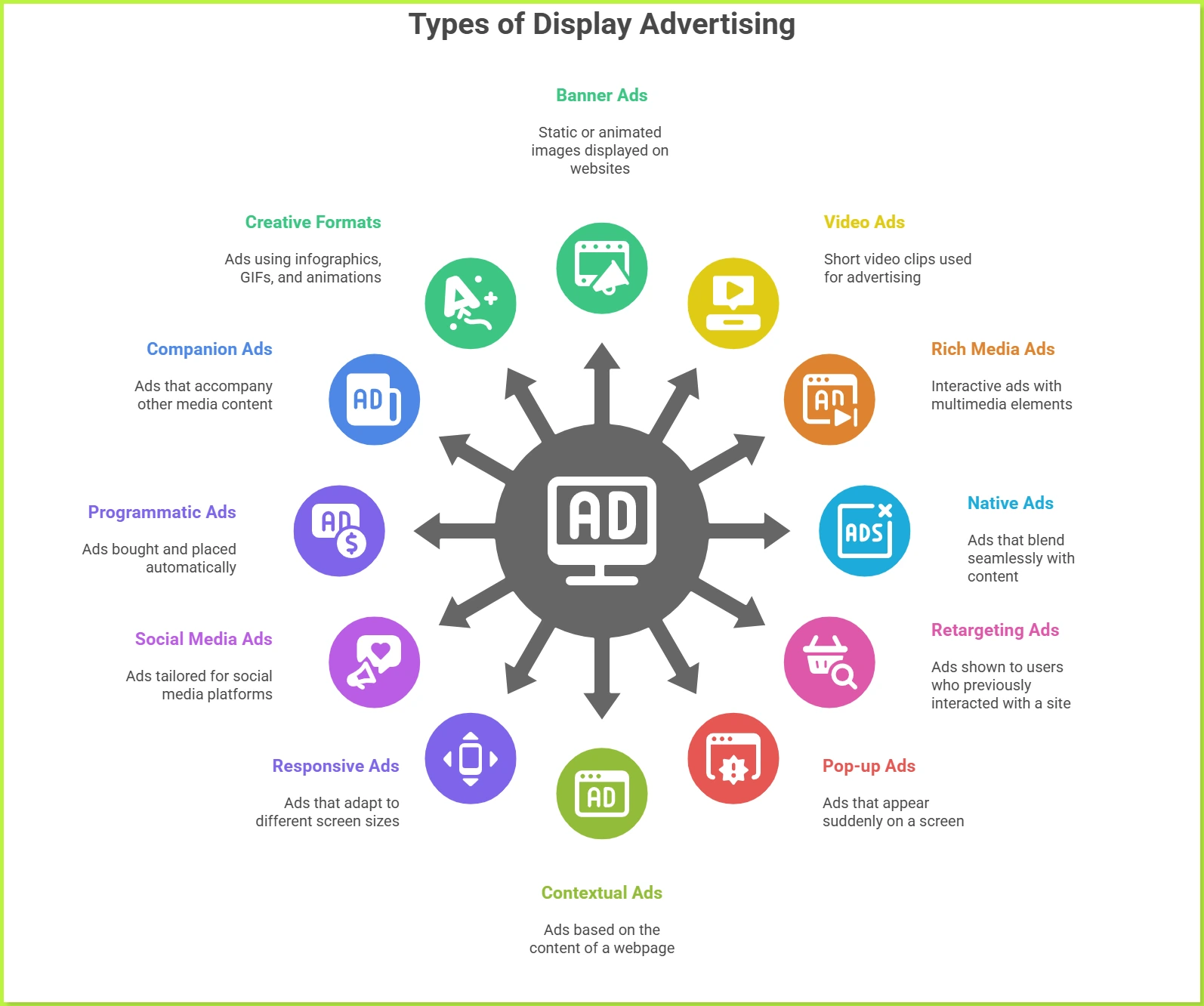
- Banner Ads
- Video Ads
- Rich Media & Interactive Ads
- Native Ads
- Retargeting (Remarketing) Ads
- Pop-ups & Interstitial Ads
- Contextual & Personalized Ads
- Responsive & Dynamic Display Ads
- Social Media & Mobile-Specific Display Ads
- Programmatic Display Ads
- Companion Ads
- Creative Formats (Infographics, GIFs, Animations)
1. Banner Ads
Banner ads are static image placements typically shown on websites or mobile apps. These familiar visuals include formats like leaderboard and skyscraper banners.
There are several benefits of banner ads in 2025. They remain effective for brand recall as they deliver consistent exposure. Visually, they look like rectangular graphics placed alongside content, often featuring bold headlines and a clickable call to action.
Common Use Cases: Engaging users, storytelling campaigns
2. Video Ads
Video ads are short clips that play before, during, or after video content, often on platforms like YouTube. They offer engaging movement and sound that can bring products to life. These ads, essential in many types of display advertising, drive higher engagement and recall.
Now, how to use video ads for product marketing? Easy! They display as embedded video players and capture attention instantly. Video ads play before video content on platforms like YouTube.
Common Use Cases: Product demos, explainer videos, testimonials.
Rich media display ads include interactive elements like hover effects, expandable panels, or embedded games designed to deepen audience engagement. Rich media display ads look dynamic and customizable.
According to Ion Interactive research, 88% of marketers say interactive content helps differentiate their brand from rivals.
Common Use Cases: Engaging users, storytelling campaigns.
4. Native Ads
Native ads are designed to blend seamlessly with the look and feel of the platform that hosts them. Native ads are often embedded in-feed or within recommendation widgets and carry editorial-style headlines.
Native ads perform well in 2025 for better engagement because they feel less intrusive and more natural to the reading experience.
Common Use Cases: Content marketing, sponsored blog posts.
5. Retargeting Ads
Retargeting ads follow users who previously visited a site but did not convert, showing them contextual and personalized display ads across the web. These contextual and personalized display ads usually show product images and relevant copy to remind users to return.
The result, retargeting ads help in grabbing results in higher conversion rates by re-engaging interested prospects.
Common Use Cases: Cart abandonment recovery, brand recall.
Pop‑ups and interstitials are full-screen or overlay ads that appear between content pages or when users perform actions. They often include exit offers or special discounts.
While they can interrupt user experience, when timed well, they deliver high conversion rates and immediate ROI.
Common Use Cases: Mobile app monetization, big announcements.
7. Contextual & Personalized Ads
Contextual ads appear alongside relevant content based on keywords or page topics. Personalized ads use user behavior, interests, and demographics to serve tailored creatives.
These ads are placed based on the content of a webpage, ensuring relevance to what the user is reading. Strong content optimization can make contextual advertising even more effective by aligning keywords and messaging with what your audience is searching for.
These formats feel relevant to users and increase CTR due to precise targeting and messaging. These formats are among the most effective types of display advertising because they deliver highly relevant messages to the right audience at the right time.
Common Use Cases: Product recommendations, content suggestions, cross-selling based on browsing history.
8. Responsive & Dynamic Display Ads
Responsive display ads automatically adjust size, format, and layout to fit different placements. Dynamic display ads pull product data to create tailored ads based on user interests.
They are effective and efficient because they adapt seamlessly across devices and audiences.
Common Use Cases: Multi-device campaigns, e-commerce promotions, seasonal product pushes.
9. Social Media & Mobile-Specific Display Ads
These ads are built for platforms like Facebook, LinkedIn, TikTok, and Instagram, often optimized for mobile viewing.
With more than 6.92 billion mobile users worldwide in 2023, mobile display ads reach audiences on the go who might skip desktop ads.
Common Use Cases: App installs, influencer collaborations, mobile-exclusive offers.
10. Programmatic Display Ads
Programmatic display ads use real-time bidding and automated systems to buy placements. They allow dynamic targeting and scaling across the web. Spending on these rose sharply.
According to a study, it’s mentioned that US advertisers increased programmatic display ad budgets by 41.2 percent from 2020 to 2021.
Common Use Cases: Large-scale brand awareness campaigns, audience segmentation, real-time targeted offers.
11. Companion Ads
Companion ads are static or rich media banners that appear alongside video or audio content on platforms like YouTube or podcast apps. Unlike mid-roll or pre-roll video ads, these display banners stay visible during playback, reinforcing the brand message without interrupting the content.
They support better brand recall and drive post-view engagement by offering a clickable CTA next to the media.
Common Use Cases: Supporting main video or audio ads, reinforcing messages during podcasts or livestreams.
Creative display ad formats such as infographics, animated GIFs, and lightweight animations are designed to capture attention through visual storytelling. Infographic ads present data in an engaging, digestible format, making them ideal for awareness campaigns.
Animated GIFs bring movement to banner or native ads without requiring video-level production.
Common Use Cases: Data-driven storytelling, educational content, visually engaging brand narratives.
📌
Pro Tip
Coordinate display ads with your email, search, and social media campaigns for consistent messaging.
Are Display Ads Still Useful in 2025?
In 2025, various types of display advertising remain a key component of digital marketing strategies, particularly when aligned with PPC campaigns.
Despite 43% of marketers viewing display ads as less effective, a striking 84% continue to invest in them, underscoring their continued importance in holistic marketing strategies.
The reach of Google Display Network is also impressive; it spans over 2 million websites, apps, and videos, reaching more than 90% of all internet users. This vast coverage makes GDN a valuable asset for SEO agencies aiming to scale brand awareness.
Performance metrics further reinforce the value of display ads. Display ads campaigns generate an average click-through rate (CTR) of around 0.46% across industries. Even with modest CTRs, display ads remain highly effective for boosting brand searches.
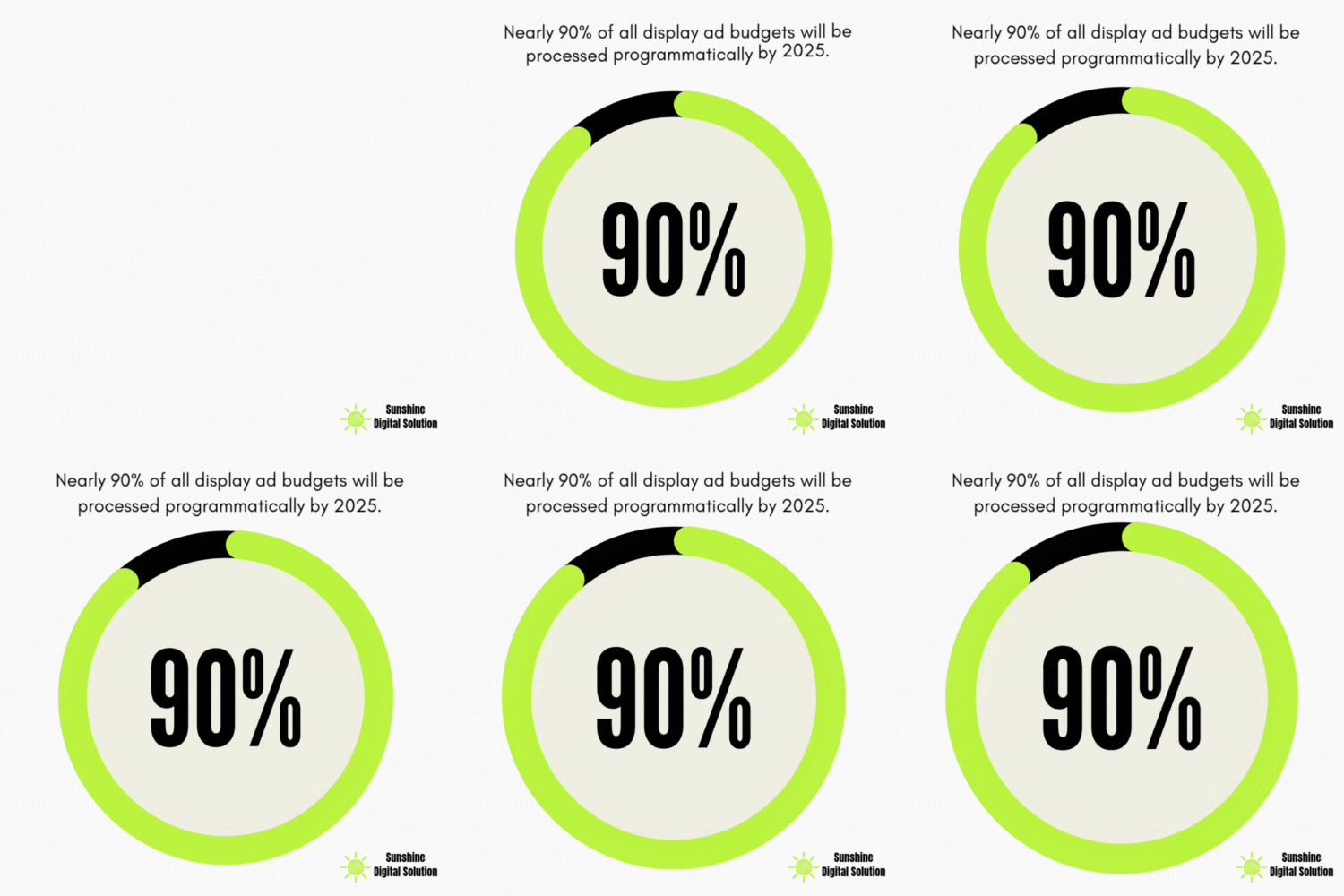
Programmatic display ads are another compelling trend; by 2025, nearly 90% of all display ad budgets will be processed programmatically, reflecting automation’s dominance in current ad buying.
Display advertising also continues to grow: global spending is projected to hit $266.6 billion by 2026, indicating strong market confidence and ongoing expansion. Taken together, these insights confirm that display ads are not only still useful but essential for achieving comprehensive marketing impact.
🚀
Pro Tip
If you’re deciding to invest in better visibility and maximize growth, you should also know when to lean on
SEO vs. PPC (paid ads).
What Are the Benefits of Display Advertising?
Display advertising plays a vital role in modern marketing strategies by expanding reach, driving awareness, and converting potential customers. “Video ads have proven to be one of the most effective formats for product marketing, with brands seeing up to a 50% higher engagement rate in 2025.” With visually rich and targeted formats, different types of display advertising enable businesses to show their brand to the right people, in the right place, at the right time.
Display ads are especially useful in the discovery phase of the customer journey, where consumers are not yet actively searching. Let’s explore the benefits of display ads below.
1️⃣ Increases Brand Visibility Across the Web
One of the strongest advantages of display ads is their expansive reach. Through massive networks like the Google Display Network, your brand can appear across millions of websites and apps.
This consistent presence builds recognition over time, even if users don’t immediately click. It keeps your name in front of your audience until they’re ready to act, making visibility a long-term asset.
2️⃣ Targets Specific Audiences With Precision
Display advertising lets you target based on demographics, interests, location, browsing behavior, and even recent search activity. This precision ensures that your ads are shown only to those most likely to engage or convert.
Whether you’re running contextual ads or personalized dynamic formats, you gain the ability to tailor your message and maximize relevance with every impression.
3️⃣ Supports Multiple Campaign Goals Simultaneously
Whether you’re focused on brand awareness, driving traffic, collecting leads, or remarketing to past visitors, display ads can do it all. You can design campaigns with multiple objectives by using various formats and targeting layers.
A single campaign might feature brand-focused banners while also using dynamic ads to drive cart abandoners back to checkout. That flexibility is a big win for advertisers.
4️⃣ Cost-Effective With Flexible Budget Options
Display ads operate on models like CPC (cost-per-click) or CPM (cost-per-thousand impressions), which means you can start with almost any budget. Smaller businesses can enter with minimal spend while testing ad variations.
As performance data rolls in, it’s easy to scale up and focus on what converts best. This makes display advertising an efficient option compared to other paid strategies.
5️⃣ Delivers Measurable Results Through Real-Time Analytics
Another key benefit is the ease of tracking. You can monitor impressions, clicks, click-through rate (CTR), conversions, and view-through data in real-time. This transparency helps marketers understand what’s working and where budget adjustments can increase ROI.
Platforms like Google Ads provide dashboards with actionable metrics that make campaign optimization quicker and more strategic.
⚠️
Watch Out Targeting Too Broadly!
Casting too wide a net wastes budget and lowers conversion rates. Narrow down your audience.