Reciprocal links are created when two websites link to each other. It was once a widespread SEO tactic.
Important Info
According to Backlinko, what really matters today is how many unique referring domains link to your site, not just the total number of backlinks.
This gap makes many website owners consider reciprocal linking. However, search engines are now much better at detecting unnatural link exchanges and can penalize sites that rely on them too heavily. In this blog, you will learn what reciprocal links are, how they work today, why they are important, and the benefits of reciprocal links.
What is a Reciprocal Link?
Reciprocal links are two-way links between websites, where one site links to another, and the second site links back. These links can happen naturally when both sites reference each other’s content or intentionally through agreements.
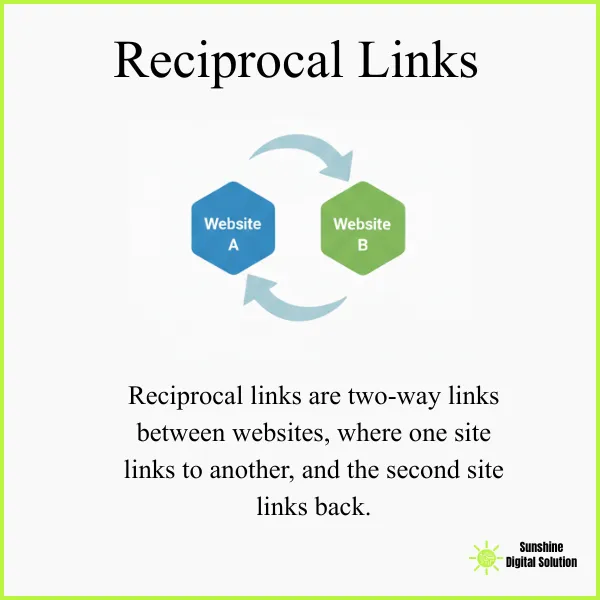 Simple breakdown of how reciprocal links work between two websites.
When used correctly, reciprocal links enhance credibility, boost organic traffic, and improve topical authority, making them an important strategy for SEO and digital marketing growth. While this exchange can be harmless, excessive reciprocal linking, especially when done for manipulation, can negatively impact SEO. The key is intention, relevance, and authenticity.
- Use reciprocal links only when they are editorial and relevant.
- Audit for patterns and excessive mutual linking.
- Prefer contextual, one-way editorial links for SEO value.
How Common are Reciprocal Links?
Reciprocal links are widespread because the internet naturally forms a network of interconnected resources. Even major authoritative websites, such as government portals, educational institutions, and leading blogs, sometimes link to one another because of shared values.
Google understands that natural reciprocity happens organically. Problems arise only when reciprocal linking becomes excessive, forced, or appears to be a link scheme intended to manipulate search rankings rather than provide genuine value.
Studies from multiple SEO platforms show that reciprocal links are widespread, even among top-ranking sites.
- A large Ahrefs sample found that many high-ranking pages contain at least one reciprocal link.
- SEMrush and independent SEO audits show that mutual linking naturally happens in partnerships, citations, podcasts, interviews, roundups, and local business associations.
Results:
- 62% had at least one reciprocal link.
- 41% had three or more mutual links with partners or collaborators.
- Only 8% showed patterns that could be considered risky (e.g., dozens of irrelevant mutual links)
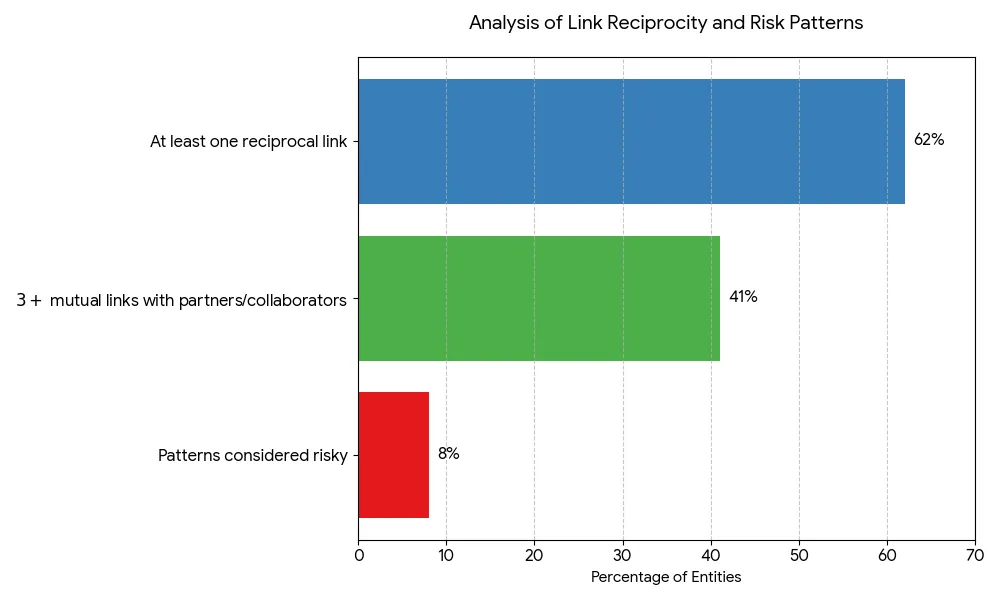 Quick view of link reciprocity patterns and potential risk signals.
Reciprocal links are regular. The risk only arises when quantity, irrelevance, or patterns indicate manipulation.
How do Reciprocal Links Affect SEO?
Whether reciprocal links are good or bad depends on the context. For example, a website publishes a blog post on Reddit SEO best practices, explaining how marketers can leverage Reddit’s platform for visibility and engagement. Within the blog, the site links to another page discussing Reddit’s site data and analytics.
The second page later links back to the SEO blog. Both links are natural, relevant, and provide value to readers, helping improve the credibility and authority of both websites.
- Increase referral traffic between two relevant websites.
- Improve user experience when both resources are genuinely helpful.
- Build topical authority through shared citations.
- Strengthen partnerships, interviews, and thought-leadership mentions.
However, when reciprocal links appear manipulative, low-quality, or part of a link-exchange network, Google may treat them as unnatural. Google’s algorithms evaluate link context, placement, anchor text, and authority to determine whether a reciprocal link supports or harms ranking potential.
Google’s algorithms can detect unnatural patterns even without a manual action, so the reciprocal links become risky when they resemble a link scheme, such as:
- Repetitive exchanges with low-quality sites.
- Exchanging links in bulk.
- Identical anchor texts across multiple mutual links.
- Swapping links with irrelevant or off-topic websites.
- Linking from sidebar, footer, or directory networks.
Reciprocal links vs. Link exchanges vs. Link schemes
Not all two-way links are the same, and understanding the difference is crucial for safe SEO practices. While reciprocal links can happen naturally and enhance credibility, link exchanges are intentional arrangements, and link schemes are manipulative setups that violate Google’s guidelines. Let us learn about each type, how to identify them, and provide examples of safe versus risky linking practices.
1. Reciprocal Links
Reciprocal links occur when two websites naturally link to each other, without any prior agreement. This usually happens because both sites provide valuable, complementary content. For example, a digital marketing blog publishes a guide on “SEO for E-commerce” and links to a web analytics tool blog explaining conversion tracking.
Later, the analytics blog references the SEO guide in its own article. Both links enhance credibility and provide value to users without manipulating rankings.
Key Takeaways:
- Organic and editorially driven.
- Relevant and contextual.
- Adds value to readers.
- Safe for SEO.
2. Link Exchanges
Link exchanges are planned agreements between webmasters to exchange links on each other’s sites. For instance, a local web design agency agrees to link to a partner hosting company, and the hosting company links back in a partner spotlight article. This strategy can improve visibility and referral traffic, but if overused or irrelevant, it risks being seen as manipulative.
The main difference from reciprocal links is intent. Link exchanges are deliberately arranged rather than occurring naturally.
Key Takeaways:
- Intentional, usually mutually beneficial.
- Should be relevant and editorial.
- Avoid excessive or automated exchanges.
- Monitor frequency to prevent SEO penalties.
3. Link Schemes
Link schemes are manipulative setups designed solely to boost search engine rankings. They include excessive two-way linking, multi-site rotations, paid link swaps, or linking from unrelated industries. For example, two unrelated blogs in different niches agreeing to link to each other 20 times each, purely to improve SEO, would constitute a link scheme.
Google’s algorithms and manual actions often penalize sites involved in such schemes, making them extremely risky for long-term SEO.
Key Takeaways:
- Violates Google’s spam policies.
- Often involves low-quality or irrelevant sites.
- High risk of ranking penalties.
- No real value to users.
Why are Reciprocal Links Important?
Reciprocal links are important because they enhance topical authority, improve the reader experience, and help establish industry relationships. When two credible websites reference each other’s expertise, it signals to search engines that both pages contribute to the same knowledge cluster.
This enhances semantic relevance, supports entity recognition, and helps Google confirm the site is trustworthy within its niche. However, importance does not justify abuse; quality and intent must always come first.
When Should You Accept or Refuse a Reciprocal Link?
Deciding whether to accept or refuse a reciprocal link is a critical step in maintaining a healthy backlink profile and protecting your SEO. Not all reciprocal links are created equal.
Some can improve your site’s authority and credibility, while others can harm your rankings if they appear manipulative or irrelevant. Now, let us discuss how to identify safe links, when to decline, and practical quality thresholds.
1. Accept a Reciprocal Link If:
Reciprocal links can benefit your SEO and credibility only when they are relevant, editorial, and trustworthy. Accept links from sites that are topically aligned with your industry, ensuring that both sites serve similar audiences. Links should appear naturally within editorial content rather than in footers, sidebars, or “links” pages, where Google may interpret them as manipulative.
- The site is topically relevant to your industry.
- The link appears inside editorial content, not in footers or sidebars.
- The site has real traffic (not just DR/DA).
- The anchor text is natural and varied.
- There is no history of excessive mutual linking.
2. Avoid or Nofollow If:
Not all reciprocal links are safe. Links from irrelevant, low-quality, or spammy sites can harm your SEO. Be cautious when a partner demands exact-match anchor texts, asks for dozens of mutual links, or places links on generic “link pages” or directories. Such links may appear manipulative and can trigger Google penalties or reduce the value of other backlinks on your site.
- The website is irrelevant or low-quality.
- The partner demands specific keywords.
- The link is placed on a “Links Page” or directory.
- They want dozens of mutual links.
Suggested Thresholds:
To consistently accept only high-quality reciprocal links, set measurable thresholds based on domain authority, organic traffic, and topical alignment. These metrics help ensure that the link provides genuine value to users and search engines while minimizing the risk of Google considering it manipulative.
- DR/DA ≥ 25 (minimum)
- Estimated monthly organic traffic ≥ 1,000
- Topical alignment ≥ 70%
These thresholds are not absolute rules, but they help you consistently accept links that enhance your SEO safely while avoiding risky exchanges. Regular audits of your reciprocal links also prevent the accumulation of poor-quality or irrelevant backlinks over time.
What are the Benefits of Reciprocal Links?
Reciprocal links offer multiple advantages when used naturally and strategically. They not only help websites share value but also enhance credibility, visibility, and user experience.
Understanding these benefits can help digital marketers, bloggers, and business owners make informed decisions about when and how to accept reciprocal links, while avoiding potential pitfalls that may hurt their local SEO strategy.
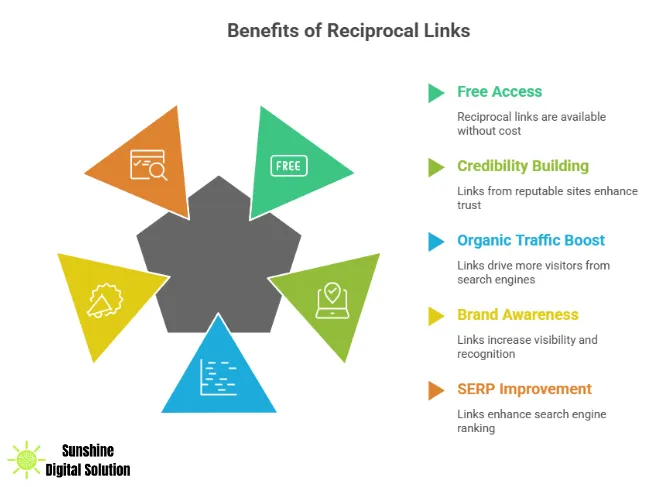 Key benefits of using reciprocal links in a balanced link-building strategy.
1. They are Free
Reciprocal links do not require payment, making them a cost-effective way to gain exposure. When two relevant sites naturally link to each other, both benefit from referral traffic and enhanced credibility without spending on ads or sponsored content. For example, a marketing blog linking to an analytics tool and the tool linking back creates a mutually beneficial, zero-cost collaboration.
2. Can Help You Build Credibility
Links from relevant, high-quality sites signal to users and search engines that your content is trustworthy. Reciprocal links, when editorially placed, demonstrate that your content is valuable enough to be referenced by peers. For instance, a local SEO agency linking to a digital marketing partner and receiving a link in return can enhance authority within the industry.
3. Can Boost Your Organic Traffic
Reciprocal links can drive targeted visitors from one site to another. If the audience overlaps, referral traffic often converts better than generic sources. For example, a blog on social media strategies linking to a case study on Instagram marketing may receive interested visitors who engage with your content, increasing both traffic and potential leads.
4. They Increase Your Brand Awareness
When another site references your content, your brand becomes more visible to new audiences. Reciprocal links naturally expose your website to readers who may not have discovered it otherwise, strengthening recognition and recall in your niche. For example, a fashion blog linking to a beauty site introduces each brand to the other’s engaged community.
5. They Can Improve Your Performance in Google’s SERPs
High-quality, relevant reciprocal links can reinforce your site’s topical authority and help search engines understand its relevance. While excessive or manipulative reciprocal links are risky, natural links signal credibility and can improve rankings for target keywords. For instance, when a marketing blog links to a trusted SEO research site and the research site links back, both benefit from improved SERP visibility.