Clients no longer search through directories to find legal help because now they turn to Google. Local SEO for law firms is the process of optimizing your online presence. Hence, your practice appears in local search results like “family lawyer near me” or “best criminal defense attorney in [city name].” It helps potential clients in your area discover your firm exactly when they need your legal expertise.
For law firms, this means ranking high in Google Maps and local packs isn’t just good for visibility; it’s crucial for getting new clients.
In this guide, you’ll learn how to boost your firm’s visibility through Local SEO for Law Firms, from optimizing your Google Business Profile to building citations, creating geo-targeted content, and earning backlinks. You’ll also find advanced SEO tips to attract more local clients and grow your practice.
Why Local SEO matters for a Law Firm?
The legal industry is one of the most competitive spaces online. Hundreds of law firms in your city are targeting the same clients and fighting for the exact keywords. Without a strong local SEO strategy, your firm can easily get buried beneath competitors on Google search results, even if you provide exceptional legal services.
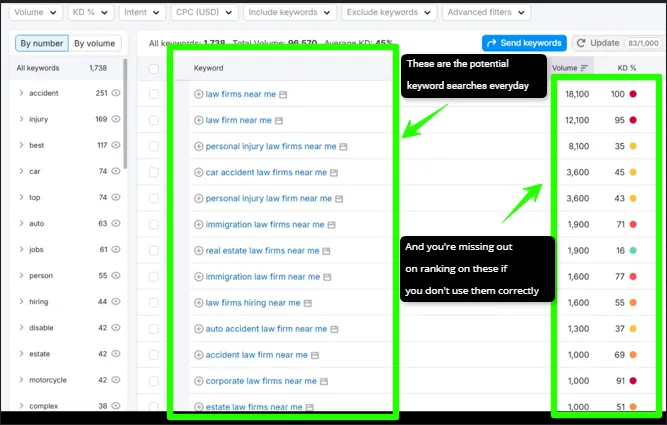
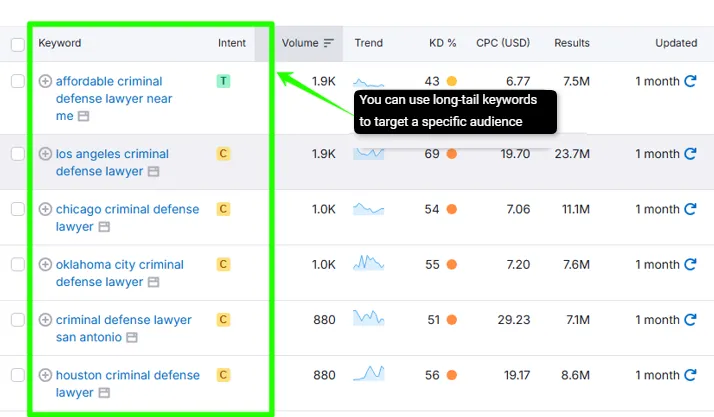
Here we have used Semrush Tool to find potential keywords.
These are potential keyword searches happening every day, and your business is missing out on ranking for them. A good Local SEO agency knows precisely which keywords to target that attract real customers in your area and drive measurable results.
Local SEO is important for small business law firms to stand out by connecting them with people who actually need their legal expertise in their area. Instead of reaching random users online, your website appears to high-intent local clients searching for terms like “personal injury lawyer near me” or “criminal attorney in Chicago.” These are the people most likely to call, visit, or schedule a consultation.
1. Builds Local Trust and Credibility
Appearing in the top local search results signals to clients that your firm is credible and trusted in the community. Reviews, ratings, and an optimized Google Business Profile help you build authority both with Google and with potential clients who see your name among the top results.
2. Targets Clients in Your Area
Local SEO allows you to focus on specific geographic areas. Whether you serve one city or multiple locations, optimizing for your region ensures your firm shows up for nearby clients seeking legal help, not for users hundreds of miles away.
3. Improves Visibility on Google Maps
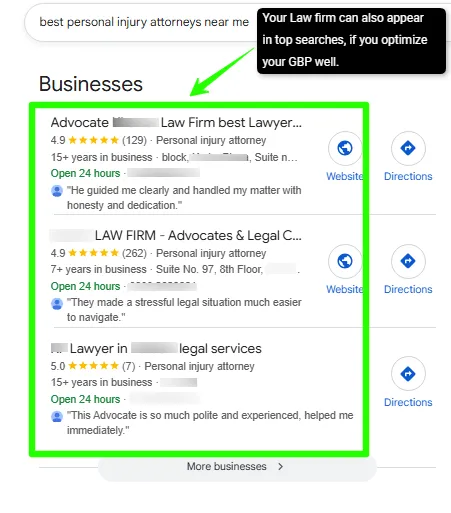
When someone searches for legal services, Google often displays a map pack showing three nearby law firms. Appearing in this Google Maps section gives your firm prime visibility, driving more website visits, phone calls, and walk-ins.
4. Reduces Dependency on Ads
While paid ads can deliver quick results, they are costly and temporary. Once the budget stops, so do the leads. Local SEO, on the other hand, builds long-term visibility and credibility, allowing you to attract consistent organic traffic without relying heavily on ads.
In short, Local SEO is a powerful law firm marketing strategy that strengthens your presence in your community, increases trust, and helps you attract local clients actively seeking legal services.
Step-by-Step Local SEO Strategy for Law Firms
Building a strong local SEO foundation takes planning and consistency. Below is a step-by-step strategy designed specifically for law firms to improve visibility, attract nearby clients, and grow online credibility. Each step focuses on key actions that make your firm stand out in local search results.
Step 1: Conduct Targeted Keyword Research for Legal Services
Before optimizing your website or Google Business Profile, you need the right keywords, the exact search phrases potential clients use to find law firms like yours. Law firm keyword research is the basis of any effective lawyer SEO strategy, helping you identify high-intent searches that convert into real clients.
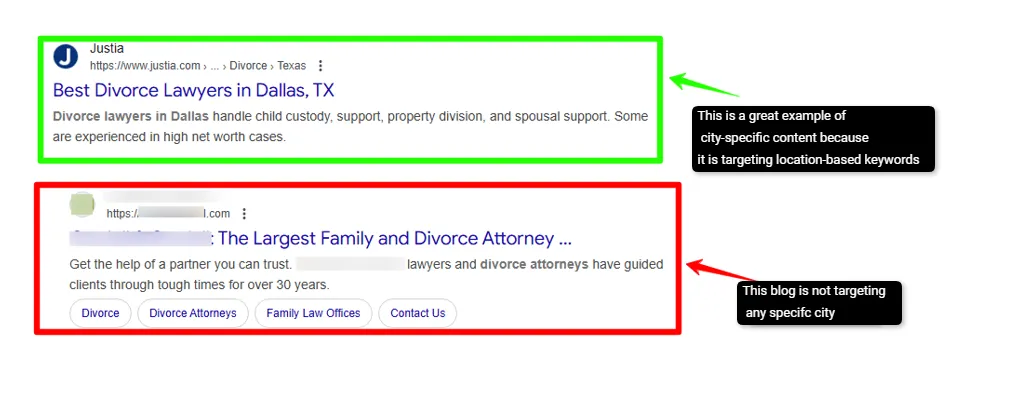
Start by listing your core legal services, such as family law, personal injury, criminal defense, or immigration law. Then, expand each service into local searches. For example, instead of targeting “divorce lawyer,” focus on “divorce lawyer in Dallas” or “best family attorney near me.” These are called location-based keywords, and they help your firm appear in searches from people actively looking for a nearby attorney.
Location-specific keywords help you target SEO to potential clients
To find valuable legal keywords, use trusted SEO tools like Google Keyword Planner, Ahrefs, or SEMrush. These tools show search volume, competition level, and keyword difficulty, helping you prioritize the most relevant and achievable terms for your area. Don’t overlook long-tail keywords, detailed, conversational phrases like “affordable criminal defense lawyer in Chicago” or “car accident attorney for uninsured drivers.” Though they get fewer searches, they attract people who are closer to hiring an attorney, giving you higher conversion potential.
Long-tail keywords can help you rank higher because they represent a more precise user intent
Modern SEO also benefits from AI-driven keyword analysis. Platforms now use AI keyword mapping to understand user intent, why someone is searching, and what stage of decision-making they’re in. This helps your law firm target not just the words people use, but the meaning behind them. For instance, AI can distinguish between a user researching “how to file for divorce” (informational intent) versus “hire divorce lawyer USA” (transactional intent).
By combining traditional tools with AI-powered insights, your keyword strategy becomes sharper and more effective, ensuring your content aligns perfectly with what potential clients are searching for online.
Step 2: Optimize Your Google Business Profile (GMB/GBP)
If you want your law firm to show up when someone nearby searches for a lawyer, your Google Business Profile (GBP), formerly known as Google My Business, is one of the most powerful tools for local SEO for law firms. This profile is what appears on Google Maps and in local results when people type something like “best personal injury lawyer near me.” A strong and well-optimized profile can help potential clients find you easily and trust your services right away.
Optimize your Google Business Profile to appear in top search results
Start by claiming and verifying your Google Business Profile. Head over to Google Business Manager and make sure your firm is listed. If it isn’t, create a new one using your exact business name and complete the verification process through phone, email, or postcard. Once verified, fill out all the necessary details. This is your law firm’s online storefront, so accuracy matters.
Keep your Name, Address, and Phone number (NAP) consistent on your website, directories, and social media. Even small spelling mistakes or mismatched details can confuse Google and reduce your local visibility.
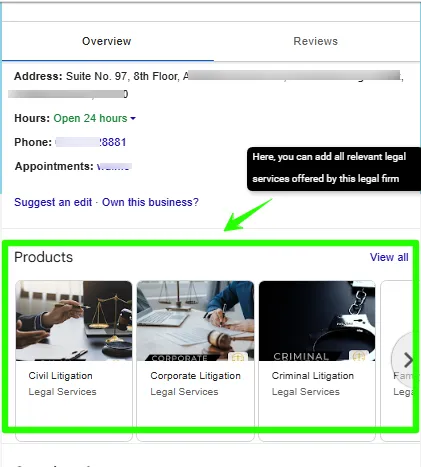
When setting up your profile, choose the business category that best fits your firm, such as Family Law Attorney, Criminal Defense Lawyer, or Immigration Attorney. Add all relevant legal services you offer so clients can clearly see what you do.
Here is an example of adding relevant legal services on your Google Business Profile.
Upload high-quality photos of your team, office, and any community events your firm has participated in. Google reports that listings with images get 42% more requests for directions and 35% more website clicks; that is a big difference.
Encourage happy clients to leave Google reviews and make sure you respond to them, even the negative ones. It shows professionalism and builds trust among new visitors.
Lastly, stay active. Post updates, announcements, or legal tips on your profile regularly. Add FAQs about your services, fees, or process to answer client questions before they even call you.
Step 3: Establish On-Page Elements for Local Search
Your website is the backbone of your law firm’s online visibility. Even if you have a verified Google Business Profile or strong citations, you still need to optimize your on-page elements to tell Google exactly who you are, what you do, and where you serve. Proper on-page SEO content optimization helps your law firm appear in relevant searches, especially when people look for legal help near them.
Here’s how to optimize your website for local on-page SEO:
1. Optimize Title Tags and Meta Descriptions:
- Every page should have a unique title and meta description that includes your primary keyword and location.
2. Use Proper Headers (H1, H2, H3):
- Your H1 should clearly describe the main topic.
- Use H2 and H3 headers to organize subtopics like “Types of Criminal Cases We Handle” or “Why Choose Our Law Firm.”
- Insert local keywords naturally, avoiding stuffing or forced phrasing.
3. Implement Schema Markup for Law Firms:
- Schema markup helps search engines understand your business details.
- Add the LocalBusiness and Attorney schema to display key information such as firm name, address, opening hours, and reviews. This increases the chances of appearing in rich snippets and Google Maps results.
4. Add Internal Links Strategically:
- Link related practice area pages (e.g., “Family Law” linking to “Child Custody”).
- Create location-specific pages if you serve multiple areas (e.g., “Personal Injury Lawyer in Seattle” linking to “Personal Injury Lawyer in Dallas”).
- Internal links help Google map your website’s structure and pass ranking power between pages.
5. Use AI-Based Content Optimization Tools:
- SurferSEO, Clearscope, or MarketMuse analyze top-ranking law firm websites and help you modify your content. They suggest optimal keyword usage, readability improvements, and updates aligned with algorithmic trends, keeping your site in line with Google’s ranking factors.
By optimizing these on-page elements, your law firm website can attract more local clients, improve click-through rates, and signal to Google that your pages deserve to appear in the top search results for local legal queries.
Step 4: Build Local Citations and Legal Directory Listings
Local citations are one of the strongest ranking signals for law firms aiming to dominate local search results. A citation is simply any online mention of your law firm’s Name, Address, and Phone number (NAP) across websites, directories, and business platforms. These listings help Google confirm your firm’s legitimacy and location, boosting your visibility in local search results and Google Maps.
Here’s how you can build strong, accurate citations for your law firm:
1. List your firm on top legal directories:
Get your law firm listed on trusted legal platforms such as Avvo, FindLaw, Justia, Lawyer.com, and LegalMatch. These sites not only improve your local SEO authority but also drive targeted traffic from people actively looking for legal services.
2. Maintain NAP consistency:
Make sure your business name, address, and phone number are written exactly the same across every directory and platform. Even small differences (like “Street” vs. “St.”) can confuse search engines and weaken your local ranking.
3. Use general directories:
Apart from legal-specific sites, add your law firm to Google Maps, Yelp, Bing Places, Apple Maps, and Yellow Pages. These platforms enhance your credibility and strengthen your overall local presence.
4. Use AI or automation tools:
Tools like BrightLocal, Moz Local, or Yext can automatically track, manage, and fix inconsistent listings across the web. Some even use AI-driven systems to detect missing or duplicate citations, saving you time and improving accuracy.
5. Regularly update your listings:
Keep your hours, contact details, and practice areas up to date. If your office relocates or changes numbers, update all directories immediately to maintain trust and ranking stability.
Building citations might sound basic, but when done right with accuracy, legal relevance, and consistency, it becomes a powerful way to strengthen your law firm’s online authority and improve its chances of showing up when potential clients search for lawyers nearby.
Step 5: Create Geo-Targeted Legal Content
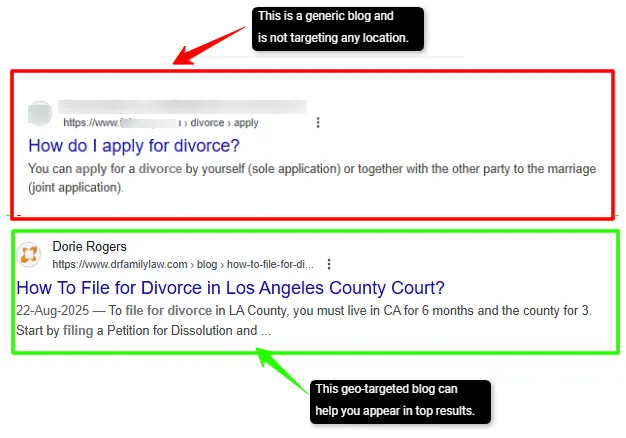
Geo-targeted content is content written with a clear local focus. It helps Google understand where your firm operates and who you serve. For instance, instead of writing a general post like “How to File for Divorce,” you can make it more powerful by saying “How to File for Divorce in Los Angeles.” This simple location-based keyword helps you appear in searches like “Los Angeles family law attorney” or “divorce lawyer near me.”
Here’s an example of using geo-targeted content to appear in search results.
1. Build Trust with Google’s E-E-A-T Principles
Google rewards law firms that demonstrate Experience, Expertise, Authority, and Trustworthiness (E-E-A-T). Here’s how to apply that:
- Experience: Share insights from real cases or client scenarios (without revealing private details).
- Expertise: Publish articles written or reviewed by actual attorneys from your firm.
- Authority: Highlight your firm’s credentials, such as certifications, bar memberships, or media features.
- Trustworthiness: Display reviews, secure site credentials, and clear contact details to reassure visitors.
When your content aligns with E-E-A-T, both search engines and readers see you as a credible legal source.
2. Create Locally Relevant Blog Topics and FAQs
People often search for answers tied to their region’s laws. Writing blogs and FAQs focused on your local legal environment increases relevance and boosts traffic. Examples include:
- “What Are Tenant Rights in San Diego?”
- “How Does Child Custody Work in Houston Courts?”
- “Steps to File for Personal Injury Compensation in Toronto.”
These questions reflect high-intent local searches; people who ask them are ready to take action.
3. Showcase Your Local Presence
Search engines value community-driven brands. Strengthen your local authority by showing your firm’s involvement in community events, pro bono work, or local seminars. This builds both trust and familiarity with potential clients nearby.
By creating geo-targeted legal content that aligns with E-E-A-T standards, your law firm can rise above generic competitors, rank higher in local results, and establish lasting trust within your community.
Step 6: Strengthen Technical SEO for Your Law Firm Website
Even the best legal content won’t perform well without a strong technical foundation. Technical SEO helps search engines crawl, index, and understand your law firm’s website, thereby improving visibility and user experience and converting visitors into clients.
In competitive legal markets, Google favors websites that are secure, fast, and mobile-friendly. A slow or poorly optimized site can drive visitors away. Strengthen your law firm’s technical SEO to ensure smooth performance and higher rankings in local and national searches. Here’s how to strengthen your law firm’s technical SEO:
1. Use HTTPS for Security
Your website must have an SSL certificate (HTTPS). It not only protects sensitive user data but also acts as a trust signal for Google. For law firms that handle client inquiries or consultations online, data protection is non-negotiable.
2. Optimize for Mobile Devices
Most clients search for legal services using their phones. Make sure your website design is mobile-responsive, meaning it automatically adjusts to different screen sizes. Test your site on Google’s Mobile-Friendly Test tool and fix issues like text overlap or unclickable buttons.
3. Improve Website Speed
A fast-loading site keeps users engaged and signals quality to search engines. Use tools like Google PageSpeed Insights or GTmetrix to check performance. You can boost speed by:
- Compressing images and videos.
- Use a reliable hosting service.
- Minimizing JavaScript and CSS files.
- Enabling browser caching and a Content Delivery Network (CDN).
4. Add and Update Your XML Sitemap
An XML sitemap tells Google about all your important website pages. It should include your homepage, practice area pages, attorney profiles, and blog sections. You can easily generate one using RankMath, Yoast SEO, or Screaming Frog. Submit it to your Google Search Console to help search engines crawl your pages faster.
5. Focus on Accessibility and Core Web Vitals
Google’s Core Web Vitals measure how smoothly your site performs in terms of loading speed, interactivity, and visual stability. Optimize these to provide a better experience for visitors:
- Largest Contentful Paint (LCP): Ensure your main content loads within 2.5 seconds.
- First Input Delay (FID): Keep interaction time under 100ms.
- Cumulative Layout Shift (CLS): Avoid sudden layout changes while loading.
Also, make your site accessible to everyone, use readable fonts, add alt text to images, and ensure clear contrast between text and background.
6. Use SEO Plugins to Stay on Track
If your law firm’s website is built on WordPress, use SEO plugins like RankMath or Yoast SEO to manage on-page optimization, meta tags, sitemaps, and readability. These tools also help you track technical issues and adapt to the latest algorithm updates.
Step 7: Build Local Backlinks and Digital PR
Backlinks are one of the most powerful signals for search engines to determine your law firm’s authority and credibility. High-quality backlinks from trusted local sources signal to Google that your firm is reputable and trustworthy, improving your local search rankings. Local backlinks not only enhance your domain authority but also connect you to potential clients and partners in your geographic area.
How to Build Local Backlinks?
Here are effective strategies for earning valuable local backlinks:
- Use Local Media Coverage: Get featured in local news outlets, magazines, or radio/TV segments. Share legal tips, commentary on recent cases, or community initiatives.
- Join Bar Associations and Legal Directories: Membership in reputable associations often comes with directory listings that provide authoritative backlinks. Examples include local bar associations, Avvo, Justia, or FindLaw.
- Sponsor Community Events: Supporting charity events, seminars, or local initiatives provides opportunities for your firm to be mentioned online by local organizations, generating backlinks.
- Guest Posting on Local Blogs and Publications: Offer to write legal insights for local business blogs, newspapers, or community websites. This positions your firm as an authority and earns backlinks.
- Engage on Quora and Reddit: You can use Quora for SEO by answering questions related to your legal practice with detailed advice, including contextual links to your site where relevant. Similarly, you can use Reddit for SEO by participating in local subreddits or legal communities and sharing helpful insights while linking naturally to your website.
- Collaborate with Local Businesses and Professionals: Partner with complementary local businesses (e.g., financial advisors, real estate firms) for co-authored content or cross-promotions.
Use AI-Based Outreach Tools
Modern AI tools can simplify link-building efforts by:
- Identifying high-quality local backlink opportunities.
- Automating outreach emails to local publications.
- Tracking backlinks and ensuring they remain active.
Benefits of High-Quality Local Backlinks
- Boost Domain Authority: Backlinks from respected local websites increase your overall site credibility.
- Enhance Local Search Rankings: Google rewards websites with authoritative, locally relevant links.
- Increase Referral Traffic: Visitors from local sites are more likely to become clients.
- Build Brand Recognition: Being mentioned in community publications reinforces your firm’s local presence and trustworthiness.
A strong local backlink profile combined with targeted digital PR efforts ensures your law firm not only ranks higher in search results but also becomes a recognized authority in your community.
Social media isn’t just about connecting with people; it’s about building your law firm’s local reputation and brand authority. Your social presence acts as an extension of your website, helping you stay visible, trusted, and top-of-mind for local clients searching for legal help.
Why Social Signals Matter for Local SEO?
Although Google doesn’t list “social signals” (likes, shares, comments) as a direct ranking factor, they indirectly influence local SEO in powerful ways. When your posts are shared or engaged with, they drive more traffic to your website, increase brand mentions, and send trust signals to search engines that your firm is credible and relevant in your community.
Strong social activity also improves your chances of appearing in Google’s “People Also Search For” results and enhances your firm’s overall online footprint.
Best Platforms for Law Firms
Every social media platform serves a different purpose, but for law firms, these three offer the best results:
- LinkedIn: Perfect for professional networking and sharing thought leadership posts or legal updates. You can also join local business groups or legal communities to build connections.
- Facebook: A great platform for running localized ad campaigns, sharing blog posts, and engaging with your local audience through comments, polls, and community updates.
- Instagram: Helps showcase your firm’s personality, highlight community participation, and share visual stories that humanize your legal brand.
Be Consistent and Interactive
Consistency and engagement are key. Google values active, trustworthy businesses, and consistent social activity reinforces that perception.
- Post regularly: Create a schedule (e.g., 3–4 times a week) to stay visible.
- Engage with your followers: Reply to comments and messages promptly.
- Tag local businesses or community pages: Builds local relevance and visibility.
- Use location-based hashtags, Such as #HoustonLawyer or #TorontoFamilyAttorney, to reach nearby clients.
Social media doesn’t replace your website’s SEO; it amplifies it. By maintaining a consistent presence on LinkedIn, Facebook, and Instagram, and aligning your content with your law firm’s SEO strategy, you create a strong ecosystem of trust, authority, and engagement.
Over time, this strengthens your local search visibility and helps potential clients see your firm as a credible, approachable legal brand.
Step 9: Analyze and Adjust Your Local SEO Performance
Building a strong local SEO strategy is only half the work; the other half is tracking your results and refining your approach. For law firms, measuring performance helps you understand what’s driving new clients and what needs improvement.

Why Tracking Matters for Law Firms?
SEO isn’t a one-time setup. Google algorithms change, competitors evolve, and user behavior shifts. Regular tracking ensures your law firm stays ahead in local search results and continues to attract qualified leads.
By monitoring your SEO data, you can:
- Identify which keywords bring the most consultations or case inquiries.
- Understand what content or pages convert best.
- Optimize your marketing budget by focusing on high-performing areas.
Key Metrics to Track
Use the following indicators to measure your firm’s SEO progress:
- Keyword Rankings: Track your position for main legal keywords like “divorce lawyer near me” or “personal injury attorney [city name].” Tools like Ahrefs, Semrush, or Google Search Console show how your visibility improves over time.
- Organic Traffic: Monitor how many visitors come to your site from Google search. A steady increase means your content and optimization are working.
- Local Pack Ranking: Check if your firm appears in the Google Maps 3-Pack for key searches. This position drives the highest click-through rates for law firms.
- Click-Through Rate (CTR): Analyze how many users click your site after seeing it in search results. A low CTR may mean your title tags or meta descriptions need rewriting.
- Leads and Conversions: Track actions that matter calls, contact form submissions, live chat inquiries, and consultation bookings.
- Google Reviews and Ratings: Monitor your firm’s review growth and sentiment. A consistent stream of positive reviews signals strong local credibility.
Best Tools for SEO Tracking
To make analysis easier, integrate these reliable tools into your law firm’s SEO workflow:
- Google Analytics 4 (GA4): Tracks overall site traffic, user behavior, and conversions.
- Google Search Console: Monitors search visibility, impressions, click-through rates, and indexing issues.
- Ahrefs or Semrush: Useful for keyword tracking, backlink analysis, and competitor research.
- Call Tracking Software (CallRail): Connects inbound calls to your marketing channels, showing which channels are really generating leads.
Create Performance Dashboards
To simplify reporting, create a custom SEO dashboard that displays your most important metrics in one place. Use tools like:
- Google Looker Studio (Data Studio) for visual SEO reports.
- HubSpot or AgencyAnalytics for lead and conversion summaries.
This helps partners or marketing managers quickly review progress without diving into raw data.
Step 10: Future of Local SEO for Law Firms (AI & GEO Optimization)
The world of SEO is changing fast, and law firms need to keep up. With new AI-powered search engines like ChatGPT, Gemini, and Perplexity becoming popular, people no longer search the same way they used to. Instead of typing short keywords, they ask detailed questions and expect clear, human answers. This shift has given rise to something called Generative Engine Optimization (GEO), the future of SEO for lawyers.
1. What Is Generative Engine Optimization (GEO)?
GEO means optimizing your law firm’s content so it shows up in AI-generated search results and summaries. Instead of fighting for a spot on Google’s first page, you’re making sure AI tools can understand and feature your content in their answers.
Here’s how to do it:
- Write natural, conversational content that sounds human, not robotic.
- Use schema markup so AI tools know exactly what your law firm does.
- Keep your business information consistent across Google Maps, local listings, and directories.
2. How AI Search Engines Are Changing SEO?
AI search tools like ChatGPT and Gemini don’t just show links; they summarize what they find. That means your firm’s content needs to be clear, credible, and trustworthy enough to be included in those summaries.
Here’s what matters most:
- Demonstrate your expertise and authority with detailed, accurate information.
- Focus on E-E-A-T (Experience, Expertise, Authority, Trustworthiness).
- Create content that answers real client questions, not just keyword phrases.
3. The Power of Geo Optimization
Even with AI taking over, location-based searches still matter for lawyers. When someone searches for “Los Angeles divorce lawyer,” Google and AI tools both prefer firms that show strong local signals.
Here’s what helps:
- Create separate pages for each service and city you serve.
- Add Google Map embeds and local keywords naturally in your content.
- Talk about local events, partnerships, or cases your firm has handled to build credibility.
4. Keep Adapting: That’s the Real Secret
The future of local SEO is about staying flexible. Search trends and algorithms will keep changing, especially with AI. But law firms that adapt by writing helpful, human-centered content and staying active locally will always stand out.
SEO for lawyers isn’t just about rankings anymore; it’s about being visible, trusted, and relevant in an AI-driven world. Start optimizing with GEO today, and your law firm will be ready for whatever the future of search brings.
Advanced Local SEO Tips for Competitive Law Firms
To get ahead of other law firms in your area, you need to go beyond basic SEO. Here are some practical, high-impact tips to help your firm stand out and attract more local clients:
1. Optimize for Voice Search
- Use natural, conversational phrases like how people talk (“best criminal lawyer near me”).
- Add question-based keywords and answers in your FAQ section.
- Keep your Google Business Profile updated with accurate contact details.
- Write short, direct answers that voice assistants can easily read aloud.
2. Make Your Website Mobile-Friendly
- Use a responsive design that adjusts to all screen sizes.
- Improve page load speed by compressing images and switching to a faster hosting provider.
- Place clear call-to-action buttons (e.g., “Call Now” or “Book a Consultation”).
- Avoid pop-ups that disrupt navigation or cover key content.
3. Create Local Landing Pages
- Build separate pages for each city or region you serve (e.g., “Divorce Lawyer in Chicago”).
- Include location-based keywords in titles, meta descriptions, and content.
- Add Google Maps embeds, office photos, and local client testimonials.
- Write unique content for each page; don’t just copy and replace city names.
4. Use Video Content to Build Local Trust
- Create short videos explaining common legal issues in simple terms.
- Introduce your attorneys and team members to build a personal connection.
- Share local success stories or case insights (without violating confidentiality).
- Post videos on YouTube, Facebook, and Google Business Profile for better reach.
5. Keep Consistency Across All Platforms
- Maintain identical NAP details (Name, Address, Phone) across your website, directories, and social profiles.
- Respond to client reviews and messages promptly.
- Keep posting fresh, local-focused content regularly to stay relevant.
Pro Tip: Combine these strategies with regular SEO tracking and analytics. When voice-friendly keywords, mobile optimization, and video engagement are combined, they can significantly boost your firm’s local visibility and credibility.
SEO vs Pay-Per-Click Ads: Which Is More Effective for Law Firms?
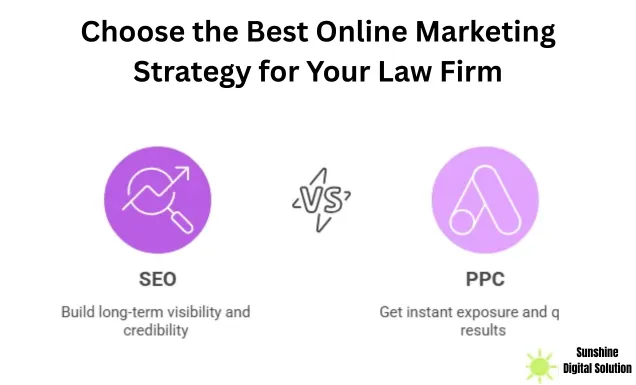
When it comes to growing your law firm online, the debate of SEO vs. PPC often comes up. SEO helps build long-term visibility, credibility, and steady client leads without paying for every click, while PPC offers instant exposure and quick results, but ends when the ads stop.
SEO vs. PPC: Choose the right online marketing strategy for your law firm
SEO: The Long-Term Growth Strategy
SEO services help your law firm appear in organic Google results when people search for services like “attorney lawyer near me.” It builds trust and credibility because users naturally prefer organic listings.
Benefits of SEO:
- Builds lasting visibility and authority
- Brings free traffic once ranked
- Strengthens your local presence on Google Maps
- Delivers consistent leads over time
PPC: The Quick Results Option
PPC ads appear instantly at the top of Google, but you pay for every click. It’s great for getting immediate leads or launching a new firm.
Benefits of PPC:
- Fast visibility and quick inquiries
- Helps test high-performing keywords
- Ideal for short-term campaigns
When it comes to PPC services, you need the best players in the game, and Sunshine Digital Solutions is the best at it. The smartest law firms use both SEO and PPC. PPC for quick exposure and SEO for long-term growth.