Shopping online has become a part of everyday life. Whether people are browsing on their laptops from home or scrolling through their phones on the go, e-commerce is growing faster than ever.
Did You Know?
Global online retail sales are expected to top $7.886 trillion in 2028, and that number keeps climbing.
With so many online stores competing for attention, standing out isn’t easy. Even if your eCommerce store doesn’t have a physical location, Local SEO can still make a big difference. Optimizing for local searches helps you reach nearby customers who are ready to buy, connects your brand to your community, and drives traffic that’s more likely to turn into real sales.
In this blog, we’ll share simple, practical marketing and growth strategies for Local SEO eCommerce businesses. By the end, you’ll know how to get your store noticed locally, attract loyal customers, and grow your sales all without leaving your online setup.
What is Local SEO for eCommerce and Why Does It Matter?
Local SEO is all about making your business visible to people searching for products or services in a specific location. Unlike traditional SEO, which focuses on ranking for broad keywords like “running shoes” or “handmade jewelry,” local SEO targets searches that include a location or show local intent, such as “running shoes near me” or “handmade jewelry in Chicago.”
For example, someone searching for a “therapy center” might get general results across the country, but a search for “therapy center near me” brings up local clinics that are easy to reach. That’s the power of local SEO. It connects customers with businesses near them.
For eCommerce stores, local SEO isn’t just about foot traffic. It helps you:
- Attract targeted traffic: People searching locally are often ready to buy, so they’re more likely to convert.
- Boost conversion rates: Local searchers trust businesses that appear at the top of local results.
- Build trust and credibility: Being visible in local search shows your business is active and reliable in your area.
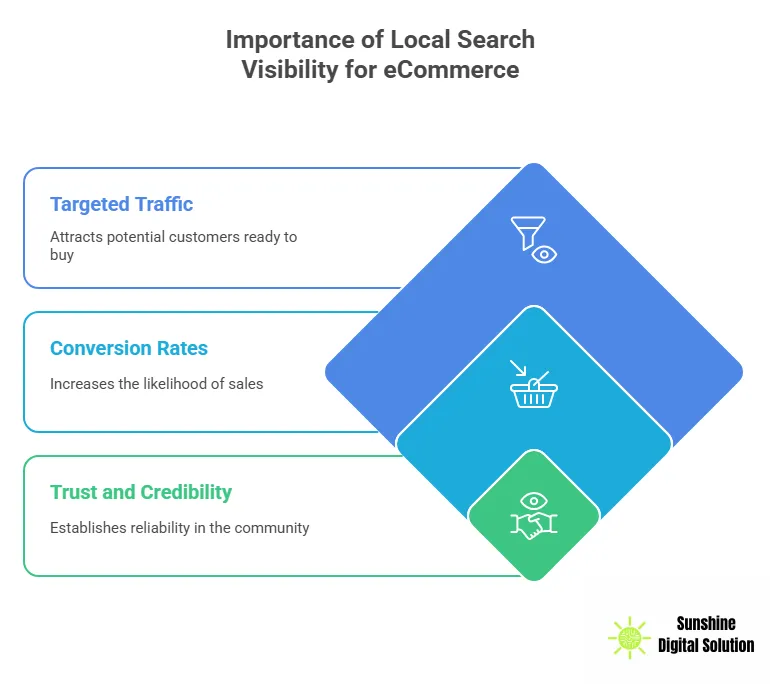 Local SEO is essential to increase the visibility of your ecommerce store.
Even online-only stores can benefit. By optimizing your eCommerce site for local searches, you can reach customers nearby who want fast shipping, local promotions, or region-specific products, which gives you an edge over competitors.
What are the Benefits of Local SEO for eCommerce?
Local SEO isn’t just for businesses with physical storefronts. Even online stores can gain a significant advantage by optimizing content for local searches. Here’s why it matters:
1. Target High-Value Markets: Instead of spreading your marketing efforts everywhere, local SEO helps you focus on regions that bring the most sales. This means reaching customers who are more likely to buy.
2. Build Trust and Credibility: When your store shows up in local search results, people see you as a reliable, active business. A strong local presence makes shoppers feel confident choosing you over competitors.
3. Stay Competitive: Many eCommerce brands are already using local SEO to their advantage. By optimizing your online store for local searches, you stay ahead of the competition.
4. Capture Mobile and ‘Near Me’ Searches: Mobile and voice searches like “best coffee beans near me” are growing rapidly. These users often have high purchase intent, giving you a better chance of converting them into customers.
5. Adapt to Changing Search Algorithms: Google increasingly prioritizes local and personalized search results. By implementing local SEO strategies, your store stays visible even as search trends evolve.
In short, local SEO helps online stores connect with the right customers at the right time, improving visibility, credibility, and sales without extra guesswork.
How to Optimize Your eCommerce Store for Local SEO?
Optimizing for local SEO is important for small businesses and eCommerce stores. Local SEO helps you reach nearby customers, improve search visibility, and drive more sales. It’s about making sure your store shows up when people in your target area are ready to buy.
The following are the easy steps to optimize local SEO for an eCommerce store:
1. Optimize Product Pages for Better SEO Results
For ecommerce businesses targeting customers in specific regions, optimizing local product pages can significantly improve visibility and sales. The following are simple ways to do it:
1. Use Location-Based Keywords
Incorporate regional keywords as part of your local SEO for multiple locations strategy to match how customers in different areas search online. Instead of using broad terms like “leather shoes,” use location-specific phrases such as “leather shoes in Los Angeles” or “handcrafted leather shoes near me.” Include these keywords naturally in product titles, meta descriptions, and page content to boost visibility across all your target locations.
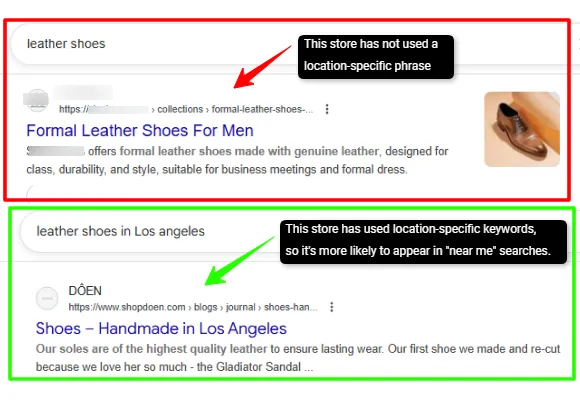 Here is an example of incorporating location-specific keywords to increase visibility.
2. Write Detailed Product Descriptions
Provide clear, helpful information about each product. Include details like materials, dimensions, colors, and benefits. The more specific and valuable your content is, the more likely search engines will understand its relevance to local users.
3. Add High-Quality Visuals
Use sharp, well-lit product images and short demo videos to capture attention. Visuals not only enhance user experience but also increase time spent on your page, signaling quality to search engines.
4. Maintain Accurate Business Information
Mention your store’s name, address, and contact details on product pages. Consistent local information helps search engines link your pages with your business location, boosting local search rankings.
2. Focus on Search Intent, Not Just Content Volume
Creating more content alone doesn’t guarantee better rankings. What truly matters is how well your content aligns with what users are actually searching for.
1. Focus on Intent Over Quantity
Since Google’s Helpful Content Update, the focus has shifted from publishing large amounts of content to creating content that matches user intent. For ecommerce websites, this means writing with purpose rather than volume.
2. Understand the Buyer’s Journey
Before adding content to product or category pages, identify what users are looking for. Someone searching for “best running shoes for women” is likely researching, while “buy Nike running shoes online” indicates purchase intent. Tailor your content to match that intent.
3. Write Purposeful Product and Category Content
Include relevant details that help users make informed buying decisions, such as product features, benefits, comparisons, and FAQs. Avoid adding long, blog-style articles to category pages, as they attract informational searchers instead of potential buyers.
4. Align Content with Conversion Goals
Each page should guide visitors toward taking action, adding to cart, checking out, or exploring related items. Content that matches search intent not only improves rankings but also drives qualified traffic that converts.
By prioritizing search intent over sheer content volume, eCommerce websites can attract the right audience and increase conversion rates.
3. Use Google Business Profile
Your Google Business Profile (GBP) isn’t just for physical stores, but it’s also valuable for eCommerce brands. Even if you don’t have a storefront, you can create a service-area profile that highlights the regions you serve and builds local visibility.
 Here’s a real stat about people not using Google Business Profile for their e-commerce brands.
Make sure your profile has:
- Accurate business details: Include your name, website, contact information, and service areas.
- Relevant categories: Choose categories that best describe your products or business type.
- Clear descriptions: Write a short, engaging summary that tells people what you sell and where you deliver.
Add high-quality images of your products, packaging, or team to make your profile feel trustworthy and personal. A complete, updated GBP helps your store appear in local search and Google Maps, making it easier for nearby customers to find and shop with you.
4. Optimize for Mobile and Voice Search
A growing number of local searches happen on mobile devices, and many come through voice assistants like Siri, Alexa, or Google Assistant. That’s why to stay visible, your eCommerce store needs to be optimized for both mobile and voice search.
Here’s what to focus on:
1. Mobile-first design: Make sure your website adapts to all screen sizes, with easy navigation and a clean layout that keeps users engaged.
2. Fast-loading pages: Speed matters. Compress images, use lightweight themes, and remove unnecessary plugins to improve loading time and keep visitors from leaving.
3. Conversational keywords for voice search: Optimize your content for how people actually talk. Use natural, question-based phrases like “Where can I buy handmade candles in Virginia?” to appear in voice search results.
Together, these elements create a smooth user experience that not only boosts engagement but also improves your store’s visibility in local and mobile search results.
5. Build Local Backlinks
Local backlinks are links from trusted websites in your area, and they play a significant role in improving your eCommerce store’s local search rankings. These links signal to Google that your business is credible and connected to the local community.
Here are some practical ways to build strong local backlinks:
1. Partner with local influencers: Collaborate with content creators or bloggers who have a strong local following. Their mentions or reviews can drive both traffic and trust.
2. Get featured in regional publications: Reach out to local news sites, magazines, or online journals to share your story, product launches, or community involvement.
3. Sponsor local events or causes: Event sponsorships not only support your community but often come with backlinks from the event’s website or social media pages.
4. Join local business directories: List your store in reputable local directories or eCommerce listings related to your niche.
5. Collaborate with local businesses: Partner with nearby brands for cross-promotions or joint campaigns that include website mentions and backlinks.
By building these connections, your eCommerce store strengthens its local online presence, gains referral traffic, and earns the kind of trust that boosts both visibility and conversions.
6. Encourage Customer Reviews
Customer reviews play an important role in both building trust and improving local search rankings. Positive reviews show potential buyers that your store is reliable, while regular feedback signals to Google that your business is active and trustworthy.
Here’s how you can encourage more reviews:
1. Send follow-up emails: After a purchase, send a friendly email asking customers to share their experience.
2. Share direct review links: Make it easy for customers by including a direct link to your Google Business Profile or product review page.
3. Respond to feedback: Thank customers for positive reviews and address negative ones politely. This shows that you value customer opinions and care about improving.
Consistent engagement with reviews helps you build credibility, attract repeat customers, and strengthen your visibility in local search results.
Technical eCommerce SEO Tips
Technical SEO is the backbone of your eCommerce website. It ensures that your store is fast, secure, and easy for both users and search engines to navigate. When done right, it improves rankings, reduces bounce rates, and creates a smooth shopping experience.
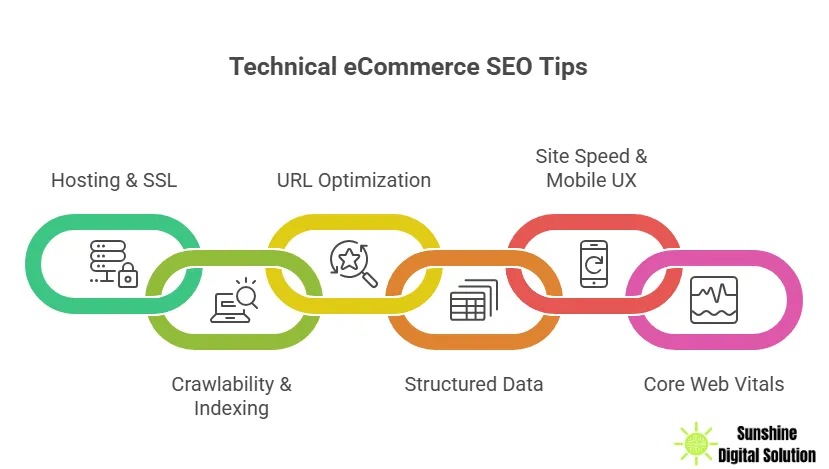
Follow these technical SEO tips for better eCommerce visibility.
Here are a few technical SEO tips to increase the visibility of your online store:
1. Hosting & SSL
- Choose a reliable hosting provider: A stable provider keeps your site fast and accessible at all times. Frequent downtime can harm your SEO routine and user trust, especially during high-traffic periods like sales.
- Secure your site with HTTPS: Adding an SSL certificate encrypts sensitive information such as payment details and login credentials. HTTPS also displays a padlock icon in the browser, signaling safety and credibility to customers, something Google prioritizes in its rankings.
2. Crawlability & Indexing
- XML Sitemap: A sitemap helps search engines discover and understand your site’s structure. Submit it to Google Search Console to ensure all important product and category pages are crawled and indexed.
- robots.txt File: Use this file to tell search engines which pages they can or can’t access (for example, block internal admin or cart pages). Proper configuration prevents wasted crawl budgets.
- Canonical Tags: These tags help avoid duplicate content issues by telling search engines which version of a page is the “main” one. This is crucial when the same product appears in multiple categories.
3. URL Optimization
- Use clean, descriptive URLs: Short, keyword-rich URLs make it easier for users and search engines to understand what a page is about.
- Avoid duplicate URLs: Ensure each product or page has a unique URL to prevent dilution of rankings and confusion.
4. Structured Data
- Use product schema markup: Add structured data to your product pages so search engines can easily identify key details such as price, stock status, brand, and ratings.
- Enable rich snippets: Structured data helps your listings stand out in search results with star ratings, pricing, and availability, making them more attractive and clickable.
5. Site Speed & Mobile UX
- Optimize images: Compress and resize images without compromising quality. Use next-gen formats like WebP to improve load times.
- Enable lazy loading: Load images and videos only when users scroll to them, improving initial load time.
- Responsive design: A mobile-friendly layout ensures smooth navigation and readability across all devices, especially smartphones, where most local searches happen.
- Test regularly: Use tools like Google PageSpeed Insights or GTmetrix to identify and fix performance bottlenecks.
6. Core Web Vitals
Core Web Vitals are a set of metrics Google uses to measure real-world user experience. They focus on how quickly your website loads, responds, and remains visually stable. Here’s what they include:
- Largest Contentful Paint (LCP): Measures how fast the main content of a page (like images or text blocks) loads. Aim for under 2.5 seconds to keep visitors engaged.
- First Input Delay (FID): Measures how quickly your website responds when a user interacts with it (e.g., by clicking or tapping). It should be under 100 milliseconds for smooth interactivity.
- Cumulative Layout Shift (CLS): Monitors how much content moves around as the page loads. A good score is less than 0.1. It ensures the layout stays stable and avoids accidental clicks.
Improving these metrics enhances user satisfaction, lowers bounce rates, and signals to Google that your site provides a high-quality experience, boosting both SEO performance and conversions.
What are Content Strategies for eCommerce SEO?
Strong content is the spine of every successful eCommerce SEO strategy. It helps your store rank higher, attract engaged visitors, and convert them into paying customers.
Here’s how to create content that drives both traffic and trust:
1. Unique Product Descriptions
Avoid copying manufacturer descriptions, as duplicate content can hurt your rankings. Write unique, easy-to-read descriptions that highlight product benefits, key features, and how they solve customer problems. Use your audience’s natural language to make your products feel relatable and authentic.
2. High-Quality Images and Videos
Visuals play a significant role in online buying decisions. Use high-resolution, original product photos and include short demo videos where possible. Optimize image file names, alt text, and video captions with target keywords to boost visibility in Google Image and Video search.
3. Optimized Category Pages
Each category page should have a clear focus. Use short, descriptive URLs, relevant keywords, and a concise introduction describing what the category offers. These pages help users navigate more easily and improve internal link flow, thereby strengthening overall site authority.
4. Engaging Blog Content
Use your blog to answer buyer questions, share guides, and publish trend-based content that links back to your product pages. For instance, if you sell skincare products, write blogs about “morning skincare routines” or “how to choose the right moisturizer.” This builds authority and attracts high-intent Google traffic.
5. Reviews and Social Proof
Showcasing genuine customer reviews, testimonials, and user-generated photos builds credibility and trust. Positive reviews not only influence buying decisions but also help your store appear in rich snippets on Google, improving your click-through rate.
Site Structure, Navigation, and Internal Linking!
A clear, logical website structure helps both users and search engines understand your store. It ensures that visitors can find what they’re looking for quickly, while Google can efficiently crawl and index your pages.
1. Logical Navigation
Organize your site hierarchy from broad to specific. Starting with the main menus, then categories, subcategories, and finally product pages.
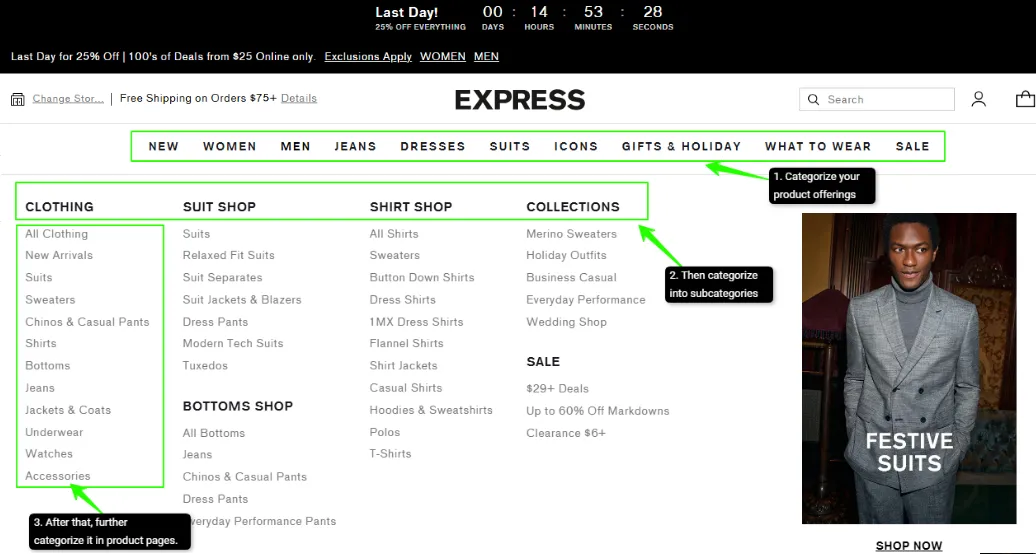 The Express eCommerce store is a good example of logical website navigation.
This clean flow improves user experience and helps search engines interpret the relationship between pages.
2. Internal Linking
Add internal links to connect related pages across your website. Link product pages to relevant blog posts, landing pages, and complementary products to guide users through your store naturally. Strong internal linking distributes page authority evenly and boosts the ranking potential of deeper pages.
3. Optimized Footer Links
Include links to essential pages like About Us, Contact, Shipping & Returns, FAQs, and Privacy Policy in your footer. These not only help users find key information quickly but also signal to search engines that your site is well-structured and trustworthy.
How to Create Marketing & Growth Strategies for eCommerce?
Building long-term growth for your eCommerce business goes beyond SEO. Strategic marketing efforts across multiple channels help you reach more customers, strengthen brand awareness, and drive consistent sales.
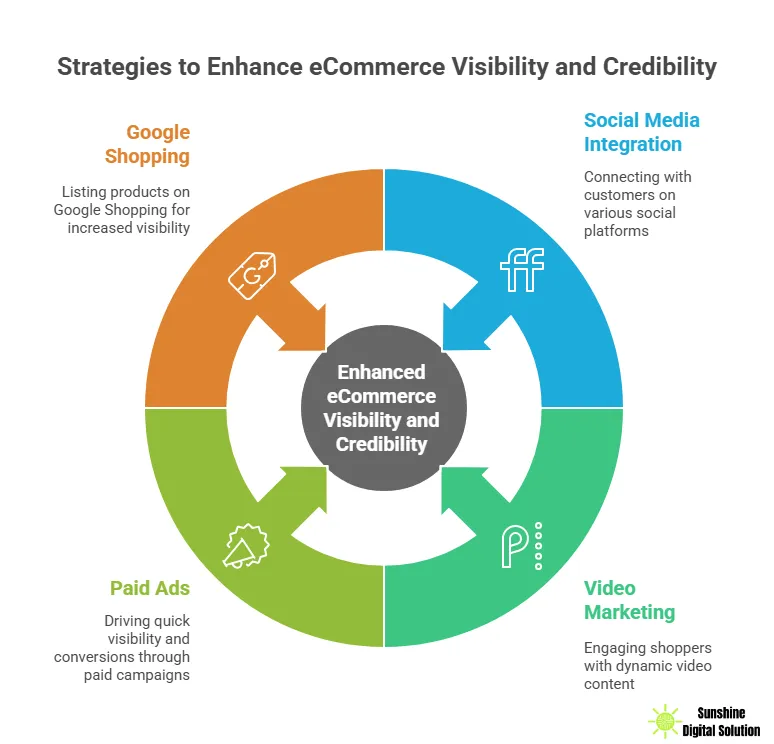
Follow these strategies to enhance your eCommerce store’s visibility and credibility.
1. Social Media Integration
Connect your store with platforms like Instagram, Facebook, TikTok, Pinterest, and other community platforms. You can use Reddit for SEO to participate in niche discussions and build authentic backlinks, and use Quora for SEO by answering relevant questions and driving targeted traffic to your store. Share product updates, customer stories, and promotions to engage your audience where they spend most of their time. These social signals strengthen brand presence, boost visibility, and improve credibility in search results.
2. Video Marketing
Videos are one of the most powerful ways to connect with shoppers. Use product demos, unboxing videos, or behind-the-scenes clips on YouTube or directly on your website. Video content increases engagement, helps explain your products better, and improves user retention, all of which indirectly support SEO.
3. Paid Ads
Paid campaigns on Google, Meta, or TikTok can drive quick visibility and conversions. Investing in PPC services helps you target specific audiences, promote seasonal offers, and test new markets effectively. Use these campaigns to complement your SEO efforts, not replace them. Combining organic growth with paid reach gives your eCommerce store both short-term traffic and long-term sustainability.
4. Google Shopping & Merchant Center
List your products on Google Shopping through the Merchant Center to appear in free product listings and paid ad placements. This improves product visibility and attracts high-intent shoppers who are ready to buy.
Platform-Specific SEO Tips!
Every eCommerce platform has its own SEO strengths and challenges. Focusing on platform-specific optimization ensures your store performs well in search results and provides a smooth customer experience.
1. WooCommerce SEO
- Use plugins like Yoast SEO to manage on-page optimization, including meta titles, descriptions, and XML sitemaps.
- Write unique product descriptions instead of relying on manufacturer content.
- Compress images to improve load speed and user experience.
- Add a product schema to display details such as prices, ratings, and stock availability in search results.
- Regularly check for broken links and duplicate content to maintain site health.
2. Shopify SEO
- Install Yoast SEO for Shopify or similar apps for easy technical and content optimization.
- Optimize product titles, meta descriptions, and URLs to make them concise and keyword-rich.
- Use structured data to improve visibility in Google’s rich results.
- Add internal links between product pages, collections, and blogs to improve navigation and crawlability.
- Use Shopify’s built-in review features to showcase customer trust and boost conversions.
SEO or PPC: What Works Best for eCommerce?
Understanding when to use SEO vs PPC is essential for eCommerce businesses because each strategy drives traffic in different ways. Choosing the right approach can help your store attract more visitors, boost conversions, and achieve long-term growth.
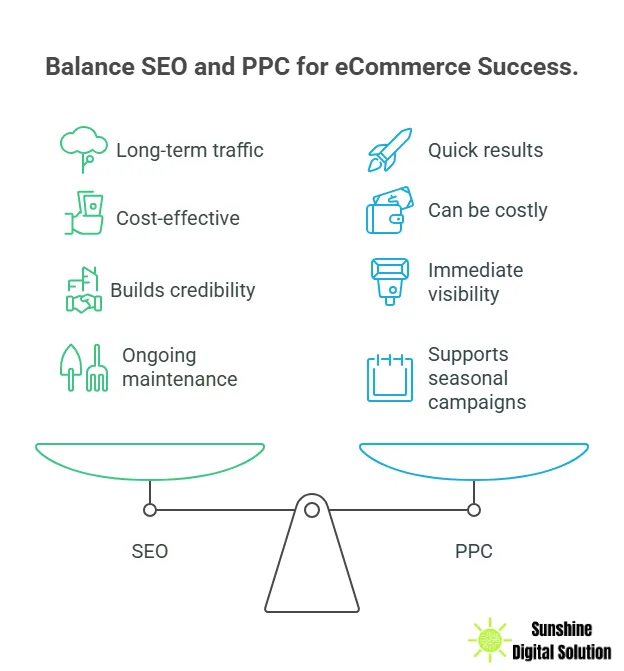
You should balance SEO and PPC for eCommerce success.
SEO (Search Engine Optimization)
- Focuses on organic search visibility.
- Involves optimizing product pages, content, site structure, and technical SEO.
- Benefits: Long-term traffic, cost-effective, and builds credibility.
- Limitations: Takes time to show results and requires ongoing maintenance.
PPC (Pay-Per-Click)
- Involves paid campaigns on Google Ads, Meta, TikTok, etc.
- Provides immediate visibility for new products, promotions, or targeted audiences.
- Benefits: Quick results, precise targeting, and support for seasonal campaigns.
- Limitations: Traffic stops once the campaign ends; it can be costly.
Combine both PPC and SEO services to achieve sustainable growth with immediate traffic and conversions.
Ready to Grow Your eCommerce Store?
Choosing an SEO agency can make all the difference in boosting your store’s visibility, attracting high-intent customers, and increasing sales. Sunshine Digital Solutions helps eCommerce businesses optimize their websites, implement effective local SEO and PPC strategies, and achieve measurable results.